Showing posts with label indonesia. Show all posts

Wednesday, 9 July 2014

Bandung, Indonesia

Bandung, Indonesia

Since Indonesia achieved independence in 1945, the city has experienced rapid development and urbanisation, transforming Bandung from idyllic town into a dense 16,500 people/km2 metropolitan area, a living space for over 2 million people. Natural resources have been exploited excessively, particularly by conversion of protected upland area into highland villas and real estate. Although the city has encountered many problems, Bandung still attracts immigrants and weekend travelers.
Bandung, IndonesiaThe northern part of the city is more hilly than the rest; the distinguished truncated flat-peak shape of the Tangkuban Perahu volcano can be seen from the city to the north. Long-term volcanic activity has created fertile andisol soil in the north, suitable for intensive rice, fruit, tea, tobacco and coffee plantations. In the south and east, alluvial soils deposited by the Cikapundung river are mostly found.
In 1880, the 1st major railroad between Batavia and Bandung was completed, boosting light industry in Bandung. Chinese from outside the city flocked in, to help run facilities, services and selling vendor machines. The area around the train station is still recognisable as the old Chinatown district. In 1906, Bandung was given the status of gemeente and then twenty years later stadsgemeente (city municipality).
Bandung, IndonesiaIn the beginning of the 1920s, the Dutch East Indies government made plans to move the capital of Dutch East Indies from Batavia to Bandung. Accordingly, during this decade, the Dutch colonial government started building military barracks, the central government building and other government buildings. However, this plan, was cut short by World War II, after which the Dutch were not able to re-establish their colony.
The fertile area of the Parahyangan Mountains surrounding Bandung supports productive tea plantations. In the nineteenth century, Franz Junghuhn introduced the cinchona plant. With its cooler elevated landscape, surrounded by major plantations, Bandung became an exclusive European resort area. Rich plantation owners visited the city on weekends, attracting ladies and business people from the capital, Batavia. Braga Street grew into a promenade street with cafes, restaurants and boutique shops. Two art-deco style hotels, Savoy Homann and Preanger, were built in the vicinity of the Concordia Society, a club house for the wealthy with a large ballroom and a theatre. The nickname "Parijs van Java" was given to the city.
After the Indonesian Independence in 1945, Bandung was determined as the capital of West Java province. During the 1945â€"1949 independence struggle against the Dutch when they wanted to reclaim their colonies, Bandung was one of the heaviest battle places. At the end of World War II nearly no Dutch troops were in Java. Before restoring Dutch sovereignty, the British took a military hold on Java's major cities. The British military commander set an ultimatum for the Indonesian combatants in Bandung to leave the city. In response, on 24 March 1946, much of the southern part of Bandung was deliberately set alight as the combatants left; an event known as the Bandung Lautan Api or 'Bandung Sea of Flame'.
In 1955, the 1st Asian-African Conference â€" also known as the Bandung Conference â€" was held in Bandung by President Soekarno, attended by head of states representing twenty-nine countries and colonies from Asia and Africa. The conference venue was at the Gedung Merdeka, the former Concordia Society building. The conference announced 10 points of declaration on world peace promotion and oppositions against colonialism, known as the Declaration of Bandung, which followed by wave of nationalism movements around the globe and remapped the world politics. The conference was also the 1st international conference of people of colour in the history of mankind. Richard Wright in his book, The Color Curtain, captured the epic meanings of the conference for people of colour around the world.
In 2005, the concurrent Asian-African Conference also taking partly in Bandung, bringing world figures such as President of Indonesia Susilo B. Yudhoyono, President of China Hu Jintao, Prime Minister of India Manmohan Singh, President of South Africa Thabo Mbeki, President of Nigeria Obasanjo, and countless other luminaries.
In 1987, the city boundary was expanded with the Greater Bandung plan; a relocation of higher concentration development outside the city in an attempt to dilute some of population in the old city. During its development, however, the city core is often uprooted, old faces are torn down, lot sizes regrouped, and what was idyllic residence is bustling chain supermarkets and rich banks.
Most of Bandung's population are of Sundanese descent. Javanese people are the largest minority; they mostly come from the nearby province and the eastern part of Java. Other minorities include Minangkabau people, Chinese Indonesians and Batak.
Bandung is home to numerous examples of Dutch colonial architecture; most notably the tropical Art Deco architectural style. Henri Maclaine-Pont was among the 1st Dutch architects to recognise the importance of combining each architectural style with local cultural traditions. He stressed that modern architecture should interact with local history and native elements. In 1920, Pont planned and designed buildings for the 1st technical university in the Dutch East Indies, Technische Hogeschool te Bandung, after which he was named as a professor in architecture at the university. A striking local Sundanese roof style is clearly seen adorning the top of the campus' ceremonial hall, embedded in his artwork.
In the same year, another Dutch architect J Gerber designed Gouverments Bedrijven in line with the colonial government plan to move the capital from Batavia to Bandung. The building is an example of a harmonious mixture between West and East architectural styles, particularly the Italian Renaissance style of arch structures in the west wing and Thailand's pagoda-like structures in the middle section. The building is known as Gedung Sate, named after the distinguished small satay-shaped structure on the roof, and is today used as the head office of West Java provincial government and West Java's house of representative.
The modern and native architectural blending was followed by several Dutch architects that have shaped the city landmarks. In the 1930s, Bandung was known also as the city of architecture laboratory because of the many Dutch architects who experimented with new architectural designs. Albert Aalbers added the expressionist architecture style to the Art Deco by designing the DENIS bank and renovated the Savoy Homann Hotel (1939). C.P.W. Schoemaker was one of architects who strongly added native elements in his artworks, including the Villa Isola (1932), Hotel Preanger (1929), the regional military headquarter (1918), Gedung Merdeka (1921) and ITB Rectorate Building (1925).
Bandung is a popular weekend destination of residents of Jakarta. The cooler climate of the highland plantation area, the varieties of food, the cheaper fashion shops located in factory outlets and distros, golf courses, and the zoo, are some of the attractions of the city. Bandung is also a popular shopping destination for the good value of its textile and fashion products among Malaysians and Singaporeans.
In the 1990s, local designers opened denim clothing stores along Cihampelas Street which transformed into a "jeans street". The city attracts people from other big cities to buy local fashion wears, as they are cheaper than branded items. Beside at Cihampelas Street, many factory outlets also opened at Riau Street, Setiabudi Street, and Djuanda Street. Textile factories on the outskirts of Bandung have opened factory outlets on site selling what is marketed as sisa export (rejected or over-produced export quality items). Bandung Supermal, Bandung Indah Plaza, Ciwalk (abbreviation of Cihampelas Walk) and Paris van Java are popular shopping centres in Bandung.
Bandung is the home town of the Persib Bandung football team. Another team, Persikab, is based in the neighbouring town of Soreang, the capital city of Bandung Regency and Pelita Jaya Jawa Barat. It shares its home base stadium with Persikab at Si Jalak Harupat stadium in Soreang and Pro Duta. Persib Bandung's home base stadium is Siliwangi Stadium. Other popular sports in Bandung include badminton. The roads leading up to Lembang and Dago are popular routes for mountain cycling during the weekend. In the hillside around Bandung, there are several golf courses.
Bandung can be accessed through highways from Jakarta. An intercity toll highway called Cipularang toll road, connecting Jakarta, Karawang, Purwakarta, Padalarang and Bandung, has recently been completed in May 2005. It is currently the fastest way to go to Bandung from the capital. Driving time is about 1.5 hours on average. There are 3 other options: the Puncak route, Purwakarta route (Jakarta-Cikampek-Purwakarta-Cikalong Wetan-Padalarang-Cimahi-Bandung) and the Subang route (Jakarta-Cikampek-Subang-Lembang-Bandung). From eastern part of the cities (Cirebon, Tasikmalaya and Central Java province), Bandung can be accessed through the main provincial road. Indonesian National Route 3 links Bandung towards Cilegon and Ketapang (Banyuwangi).
Bandung Husein Sastranegara International Airport serves direct domestic flights to Batam, Pekanbaru, Medan, Bandar Lampung, Surabaya, Yogyakarta, Denpasar, Semarang, Banjarmasin, Makassar, and also international services from Kuala Lumpur and Singapore. The airport is located nearby the Dirgantara aerospace complex and Dirgantara Fairground.
Bandung has two large railway stations, i.e. Bandung and Kiaracondong Stations. Other smaller stations are Cimindi, Andir, Ciroyom, Cikudapateuh, and Gedebage Stations. Railway connects Bandung to Cianjur, Jakarta, Purwakarta, Bekasi, Karawang and Cikampek to the west, and Surabaya, Yogyakarta and Solo to the east. It is also the major means of transportation for people living in suburb areas of Cimahi, Padalarang, Rancaekek, Cicalengka and Cileunyi. In 2012 Bandung Commuter Train phase-1 will be built to connect Padalarang, Cimahi, Bandung and Cicalengka. 13 Trans Metro Bandung corridors will serve as feeders. The phase-2 will connect Cicalengka to Jatinangor.
Trans Metro Bandung along Soekarno-Hatta street will be finished on August 2011 with cost of Rp13.1 billion ($1.54 million). Additional 30 buses will join the current operation of 10 buses, after all shelters have been finished.
Since 21 June 2011 Damri operator has launched 2 buses with route Cibiru-Kebon Kelapa vice versa special for women passengers only with women drivers. It accommodated the certain religion needs.
In 5 August 2011 Jusuf Kalla has announced that he would like to build a monorail in Bandung with value about Rp.4 trillion.
As of April 2012, the cable car project 'Bandung Skybridge' to connect Pasteur to Sabuga is at 90 percent of completion awaiting legal authorisation to operate. When approved, it will be operational within a year.
There are hundreds of public and private schools in Bandung. Like in other Indonesian cities, Bandung has several state-funded and administered State Junior High Schools and State High Schools (SMA Negeri). At least sixteen universities â€" three of which are state-owned â€" and 45 professional schools are scattered across the city. Education from social sciences, technology until tourism education can be found in one of those universities.

Related Sites for Bandung, Indonesia

Saturday, 5 October 2013

Indonesia : Government and politics

Indonesia : Government and politics

Indonesia#Government and politics
The Indonesian archipelago has been an important trade region since at least the 7th century, when Srivijaya and then later Majapahit traded with China and India. Local rulers gradually absorbed foreign cultural, religious and political models from the early centuries CE, and Hindu and Buddhist kingdoms flourished. Indonesian history has been influenced by foreign powers drawn to its natural resources. Muslim traders brought the now-dominant Islam, while European powers brought Christianity and fought one another to monopolize trade in the Spice Islands of Maluku during the Age of Discovery. Following three and a half centuries of Dutch colonialism, Indonesia secured its independence after World War II. Indonesia's history has since been turbulent, with challenges posed by natural disasters, corruption, separatism, a democratization process, and periods of rapid economic change.
Indonesia#Government and politicsIndonesia consists of hundreds of distinct native ethnic and linguistic groups. The largest â€" and politically dominant â€" ethnic group are the Javanese. A shared identity has developed, defined by a national language, ethnic diversity, religious pluralism within a majority Muslim population, and a history of colonialism and rebellion against it. Indonesia's national motto, "Bhinneka Tunggal Ika", articulates the diversity that shapes the country. Despite its large population and densely populated regions, Indonesia has vast areas of wilderness that support the world's 2nd highest level of biodiversity. The country has abundant natural resources, yet poverty remains widespread.
After 1900, the name Indonesia became more common in academic circles outside the Netherlands, and Indonesian nationalist groups adopted it for political expression. Adolf Bastian, of the University of Berlin, popularized the name through his book Indonesien oder die Inseln des Malayischen Archipels, 1884â€"1894. The 1st Indonesian scholar to use the name was Suwardi Suryaningrat, when he established a press bureau in the Netherlands with the name Indonesisch Pers-bureau in 1913.
Fossils and the remains of tools show that the Indonesian archipelago was inhabited by Homo erectus, popularly known as the "Java Man", between 1.5 million years ago and as recently as 35,000 years ago. Homo sapiens reached the region by around 45,000 years ago. In 2011 evidence was uncovered in neighbouring East Timor, showing that 42,000 years ago these early settlers had high-level maritime skills, and by implication the technology needed to make ocean crossings to reach Australia and other islands, as they were catching and consuming large numbers of big deep sea fish such as tuna.
From the 7th century, the powerful Srivijaya naval kingdom flourished as a result of trade and the influences of Hinduism and Buddhism that were imported with it. Between the 8th and 10th centuries, the agricultural Buddhist Sailendra and Hindu Mataram dynasties thrived and declined in inland Java, leaving grand religious monuments such as Sailendra's Borobudur and Mataram's Prambanan. The Hindu Majapahit kingdom was founded in eastern Java in the late 13th century, and under Gajah Mada, its influence stretched over much of Indonesia.
Although Muslim traders 1st traveled through Southeast Asia early in the Islamic era, the earliest evidence of Islamized populations in Indonesia dates to the 13th century in northern Sumatra. Other Indonesian areas gradually adopted Islam, and it was the dominant religion in Java and Sumatra by the end of the 16th century. For the most part, Islam overlaid and mixed with existing cultural and religious influences, which shaped the predominant form of Islam in Indonesia, particularly in Java. The 1st regular contact between Europeans and the peoples of Indonesia began in 1512, when Portuguese traders, led by Francisco Serrxo, sought to monopolize the sources of nutmeg, cloves, and cubeb pepper in Maluku. Dutch and British traders followed. In 1602 the Dutch established the Dutch East India Company and became the dominant European power. Following bankruptcy, the VOC was formally dissolved in 1800, and the government of the Netherlands established the Dutch East Indies as a nationalized colony.
For most of the colonial period, Dutch control over the archipelago was tenuous outside of coastal strongholds; only in the early 20th century did Dutch dominance extend to what was to become Indonesia's present boundaries. Despite major internal political, social and sectarian divisions during the Indonesian National Revolution, Indonesians, on the whole, found unity in their fight for independence. Japanese occupation during the Second World War ended Dutch rule, and encouraged the previously suppressed Indonesian independence movement. A later UN report stated that four million people died in Indonesia as a result of the Japanese occupation. Two days after the surrender of Japan in August 1945, Sukarno, an influential nationalist leader, declared independence and was appointed President. The Netherlands tried to reestablish their rule, and the resulting conflict ended in December 1949, when in the face of international pressure, the Dutch formally recognized Indonesian independence.
Sukarno moved Indonesia from democracy towards authoritarianism, and maintained his power base by balancing the opposing forces of the military and the Communist Party of Indonesia. An attempted coup on 30 September 1965 was countered by the army, who led a violent anti-communist purge, during which the PKI was blamed for the coup and effectively destroyed. Around 500,000 people are estimated to have been killed. The head of the military, General Suharto, outmaneuvered the politically weakened Sukarno, and was formally appointed president in March 1968. His New Order administration was supported by the US government, and encouraged foreign direct investment in Indonesia, which was a major factor in the subsequent three decades of substantial economic growth. However, the authoritarian "New Order" was widely accused of corruption and suppression of political opposition.
Indonesia was the country hardest hit by the late 1990s Asian financial crisis. This led to popular protest against the New Order which led to Suharto's resignation in May 1998. In 1999, East Timor voted to secede from Indonesia, after a twenty-five-year military occupation that was marked by international condemnation of repression of the East Timorese. Since Suharto's resignation, a strengthening of democratic processes has included a regional autonomy program, and the 1st direct presidential election in 2004. Political and economic instability, social unrest, corruption, and terrorism slowed progress, however, in the last five years the economy has performed strongly. Although relations among different religious and ethnic groups are largely harmonious, sectarian discontent and violence has occurred. A political settlement to an armed separatist conflict in Aceh was achieved in 2005.
Indonesia is a republic with a presidential system. As a unitary state, power is concentrated in the central government. Following the resignation of President Suharto in 1998, Indonesian political and governmental structures have undergone major reforms. Four amendments to the 1945 Constitution of Indonesia have revamped the executive, judicial, and legislative branches. The president of Indonesia is the head of state and head of government, commander-in-chief of the Indonesian National Armed Forces, and the director of domestic governance, policy-making, and foreign affairs. The president appoints a council of ministers, who aren't required to be elected members of the legislature. The 2004 presidential election was the 1st in which the people directly elected the president and vice president. The president may serve a maximum of two consecutive five-year terms.
The highest representative body at national level is the People's Consultative Assembly. Its main functions are supporting and amending the constitution, inaugurating the president, and formalizing broad outlines of state policy. It has the power to impeach the president. The MPR comprises two houses; the People's Representative Council (DPR), with 560 members, and the Regional Representative Council (DPD), with 132 members. The DPR passes legislation and monitors the executive branch; party-aligned members are elected for five-year terms by proportional representation. Reforms since 1998 have markedly increased the DPR's role in national governance. The DPD is a new chamber for matters of regional management.
Most civil disputes appear before a State Court ; appeals are heard before the High Court (Pengadilan Tinggi). The Supreme Court (Mahkamah Agung) is the country's highest court, and hears final cessation appeals and conducts case reviews. Other courts include the Commercial Court, which handles bankruptcy and insolvency; a State Administrative Court (Pengadilan Tata Negara) to hear administrative law cases against the government; a Constitutional Court (Mahkamah Konstitusi) to hear disputes concerning legality of law, general elections, dissolution of political parties, and the scope of authority of state institutions; and a Religious Court (Pengadilan Agama) to deal with codified Sharia Law cases.
In contrast to Sukarno's anti-imperialistic antipathy to western powers and tensions with Malaysia, Indonesia's foreign relations since the Suharto "New Order" have been based on economic and political cooperation with Western nations. Indonesia maintains close relationships with its neighbors in Asia, and is a founding member of ASEAN and the East Asia Summit. The nation restored relations with the People's Republic of China in 1990 following a freeze in place since anti-communist purges early in the Suharto era. Indonesia has been a member of the United Nations since 1950, and was a founder of the Non-Aligned Movement and the Organisation of the Islamic Conference (OIC, now the Organisation of Islamic Cooperation). Indonesia is signatory to the ASEAN Free Trade Area agreement, the Cairns Group, and the WTO, and has historically been a member of OPEC, although it withdrew in 2008 as it was no longer a net exporter of oil. Indonesia has received humanitarian and development aid since 1966, in particular from the United States, western Europe, Australia, and Japan.
The Indonesian Government has worked with other countries to apprehend and prosecute perpetrators of major bombings linked to militant Islamism and Al-Qaeda. The deadliest bombing killed 202 people in the Bali resort town of Kuta in 2002. The attacks, and subsequent travel warnings issued by other countries, severely damaged Indonesia's tourism industry and foreign investment prospects.
Indonesia's armed forces include the Army (TNIâ€"AD), Navy (TNIâ€"AL, which includes marines), and Air Force (TNIâ€"AU). The army has about 400,000 active-duty personnel. Defense spending in the national budget was 4% of GDP in 2006, and is controversially supplemented by revenue from military commercial interests and foundations. One of the reforms following the 1998 resignation of Suharto was the removal of formal TNI representation in parliament; nevertheless, its political influence remains extensive.
Separatist movements in the provinces of Aceh and Papua have led to armed conflict, and subsequent allegations of human rights abuses and brutality from all sides. Following a sporadic thirty-year guerrilla war between the Free Aceh Movement and the Indonesian military, a ceasefire agreement was reached in 2005. In Papua, there has been a significant, albeit imperfect, implementation of regional autonomy laws, and a reported decline in the levels of violence and human rights abuses, since the presidency of Susilo Bambang Yudhoyono.
Administratively, Indonesia consists of 34 provinces, five of which have special status. Each province has its own legislature and governor. The provinces are subdivided into regencies and cities (kota), which are further subdivided into districts (kecamatan or distrik in Papua and West Papua), and again into administrative villages (either desa, kelurahan, kampung, nagari in West Sumatra, or gampong in Aceh). Village is the lowest level of government administration in Indonesia. Furthermore, a village is divided into several community groups (Rukun-Warga (RW)) which are further divided into neighbourhood groups (Rukun-Tetangga (RT)). In Java the desa (village) is divided further into smaller units called dusun or dukuh (hamlets), these units are the same as Rukun-Warga. Following the implementation of regional autonomy measures in 2001, the regencies and cities have become the key administrative units, responsible for providing most government services. The village administration level is the most influential on a citizen's daily life and handles matters of a village or neighborhood through an elected lurah or kepala desa (village chief).
The provinces of Aceh, Jakarta, Yogyakarta, Papua, and West Papua have greater legislative privileges and a higher degree of autonomy from the central government than the other provinces. The Acehnese government, for example, has the right to create certain elements of an independent legal system; in 2003, it instituted a form of Sharia Law. Yogyakarta was granted the status of Special Region in recognition of its pivotal role in supporting Indonesian Republicans during the Indonesian Revolution and its willingness to join Indonesia as a republic. Papua, formerly known as Irian Jaya, was granted special autonomy status in 2001 and was split into Papua and West Papua in February 2003. Jakarta is the country's special capital region.
Indonesia lies between latitudes 11xS and 6xN, and longitudes 95xE and 141xE. It consists of 17,508 islands, about 6,000 of which are inhabited. These are scattered over both sides of the equator. The largest are Java, Sumatra, Borneo, New Guinea (shared with Papua New Guinea), and Sulawesi. Indonesia shares land borders with Malaysia on Borneo, Papua New Guinea on the island of New Guinea, and East Timor on the island of Timor. Indonesia shares maritime borders across narrow straits with Singapore, Malaysia, the Philippines, and Palau to the north, and with Australia to the south. The capital, Jakarta, is on Java and is the nation's largest city, followed by Surabaya, Bandung, Medan, and Semarang.
Indonesia's location on the edges of the Pacific, Eurasian, and Australian tectonic plates makes it the site of numerous volcanoes and frequent earthquakes. Indonesia has at least 150 active volcanoes, including Krakatoa and Tambora, both famous for their devastating eruptions in the 19th century. The eruption of the Toba supervolcano, approximately 70,000 years ago, was one of the largest eruptions ever, and a global catastrophe. Recent disasters due to seismic activity include the 2004 tsunami that killed an estimated 167,736 in northern Sumatra, and the Yogyakarta earthquake in 2006. However, volcanic ash is a major contributor to the high agricultural fertility that has historically sustained the high population densities of Java and Bali.
Indonesia's size, tropical climate, and archipelagic geography, support the world's 2nd highest level of biodiversity, and its flora and fauna is a mixture of Asian and Australasian species. The islands of the Sunda Shelf (Sumatra, Java, Borneo, and Bali) were once linked to the Asian mainland, and have a wealth of Asian fauna. Large species such as the tiger, rhinoceros, orangutan, elephant, and leopard, were once abundant as far east as Bali, but numbers and distribution have dwindled drastically. Forests cover approximately 60% of the country. In Sumatra and Kalimantan, these are predominantly of Asian species. However, the forests of the smaller, and more densely populated Java, have largely been removed for human habitation and agriculture. Sulawesi, Nusa Tenggara, and Maluku â€" having been long separated from the continental landmassesâ€"have developed their own unique flora and fauna. Papua was part of the Australian landmass, and is home to a unique fauna and flora closely related to that of Australia, including over 600 bird species.
Indonesia's high population and rapid industrialization present serious environmental issues, which are often given a lower priority due to high poverty levels and weak, under-resourced governance. Issues include large-scale deforestation and related wildfires causing heavy smog over parts of western Indonesia, Malaysia and Singapore; over-exploitation of marine resources; and environmental problems associated with rapid urbanization and economic development, including air pollution, traffic congestion, garbage management, and reliable water and waste water services. Deforestation and the destruction of peatlands make Indonesia the world's 3rd largest emitter of greenhouse gases. Habitat destruction threatens the survival of indigenous and endemic species, including 140 species of mammals identified by the World Conservation Union (IUCN) as threatened, and 15 identified as critically endangered, including Bali Starling, Sumatran Orangutan, and Javan Rhinoceros. Much of Indonesia's deforestation is caused by forest clearing for the palm oil Industry, which has cleared 18 million hectares of forest for palm oil expansion. Palm oil expansion requires land reallocation as well as changes to the local and natural ecosystems. Palm oil expansion can generate wealth for local communities if done right. If down wrong it can degrade ecosystems and cause social conflicts.
Indonesia has a mixed economy in which both the private sector and government play significant roles. The country is the largest economy in Southeast Asia and a member of the G-20 major economies. Indonesia's estimated gross domestic product, as of 2012 was US$928.274 billion with estimated nominal per capita GDP was US$3,797, and per capita GDP PPP was US$4,943 (international dollars). June 2011: At World Economic Forum on East Asia, Indonesian president said Indonesia will be in the top ten countries with the strongest economy within the next decade. The gross domestic product (GDP) is about $1 trillion and the debt ratio to the GDP is 26%. The industry sector is the economy's largest and accounts for 46.4% of GDP (2012), this is followed by services (38.6%) and agriculture (14.4%). However, since 2012, the service sector has employed more people than other sectors, accounting for 48.9% of the total labor force, this has been followed by agriculture (38.6%) and industry (22.2%). Agriculture, however, had been the country's largest employer for centuries.
According to World Trade Organization data, Indonesia was the 27th biggest exporting country in the world in 2010, moving up three places from a year before. Indonesia's main export markets are Japan (17.28%), Singapore (11.29%), the United States (10.81%), and China (7.62%). The major suppliers of imports to Indonesia are Singapore (24.96%), China (12.52%), and Japan (8.92%). In 2005, Indonesia ran a trade surplus with export revenues of US$83.64 billion and import expenditure of US$62.02 billion. The country has extensive natural resources, including crude oil, natural gas, tin, copper, and gold. Indonesia's major imports include machinery and equipment, chemicals, fuels, and foodstuffs. And the country's major export commodities include oil and gas, electrical appliances, plywood, rubber, and textiles.

Related Sites for Indonesia: Government and politics

Saturday, 28 September 2013

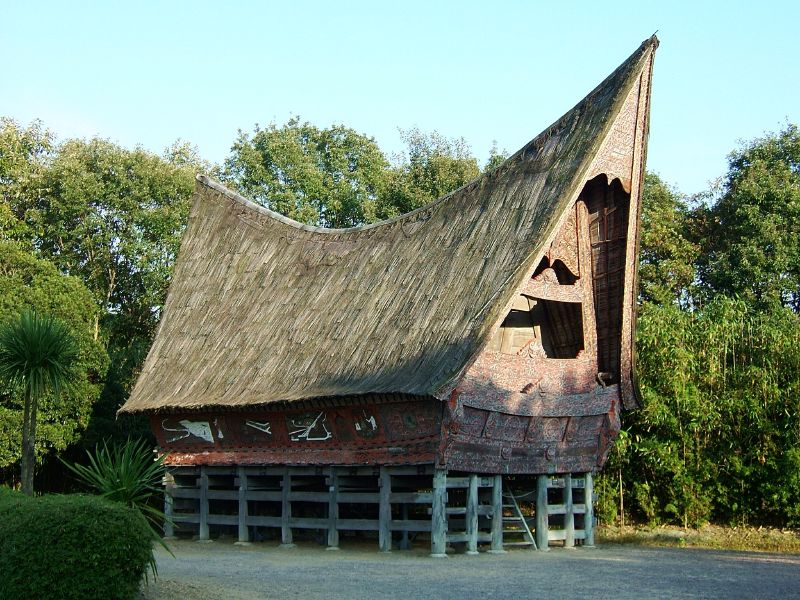
Batak in North Sumatra, Indonesia

Batak

Batak
Batak is a collective term used to identify a number of ethnic groups predominantly found in North Sumatra, Indonesia. The term is used to include the Alas, Kluet, Singkil, Karo, Pakpak, Simalungun, Toba, Angkola, and Mandailing which are distinct but related groups with distinct, albeit related, languages and customs.
In North Sumatra, Toba people typically assert their identity as 'Batak', while other 'Bataks' may explicitly reject that label, preferring instead to identify as specifically 'Simalungun', 'Karo', etc.
BatakLinguistic and archeological evidence indicates that Austronesian speakers 1st reached Sumatra from Taiwan and the Philippines through Borneo and/or Java about 2,500 years ago, and the Batak probably evolved from these settlers. While the archaeology of southern Sumatra testifies the existence of neolithic settlers, it seems that the northern part of Sumatra was settled by agriculturalists at a considerably later stage.
Although the Batak are often considered to be isolated peoples, largely because they were inland, away from influence by seafaring European colonials, there is evidence that they have been involved with trade and contact with other neighbouring kingdoms for a millennium or more. Reliable historical records of the Batak before 1800 are almost non-existent. The Bata were possibly documented in Zhao Rugua's 13th-century Description of the Barbarous People, which refers to a 'Ba-ta' dependency of Srivijaya. The Suma Oriental, of the 15th century, refers to the kingdom of Bata, bounded by Pasai and the Aru kingdom.
The Bataks were likely involved with trade with Srivijaya for benzoin and camphor, both of which were important commodities for trade with China, and grew in the Batak lands of northwest Sumatra, perhaps from the eighth or ninth centuries, and continuing for the next thousand years, Batak men carrying the products on their backs for sale at ports.
It is suggested that the important port of Barus in Tapanuli was populated primarily by Batak people. A Tamil inscription has been found in Barus dated 1088, while contact with Chinese and Tamil traders took place at Kota Cina, a trading town located in what is now northern Medan that was established in the eleventh century, and comprising 10,000 people by the twelfth century. Tamil remains have been found on key trade routes to the Batak lands.
These trading opportunities may have caused migration of Batak from Pakpak and Toba to the present-day Karo and Simalungun 'frontier' lands, where they were exposed to greater influence from visiting Tamil traders, while the migration of Batak to the Angkola-Mandailing lands may have been prompted by eighth-century Srivijayan demand for camphor.
The Karo marga or tribe Sembiring "black one" is believed to originate from their ties with Tamil traders, with specific Sembiring sub-marga, namely Brahmana, Colia, Pandia, Depari, Meliala, Muham, Pelawi, and Tekan all of Indian origin. Tamil influence on Karo religious practices are also noted, with the pekualuh secondary cremation ritual specific to the Karo and Dairi people.
From the sixteenth century onwards, Aceh increased the production of pepper, an important export commodity, and in doing so needed to import rice, which grew well on the Batak wetlands. Batak people in different areas cultivated either sawah "wet rice fields" or ladang "dry rice", and the Toba Batak, most expert in agriculture, would have migrated to meet demand in new areas. The increasing importance of rice had religious significance, increasing the power of the Batak high priests, who had responsibility for ensuring agricultural success.
Batak speak a variety of closely related languages, all members of the Austronesian language family. There are two major branches, a northern branch comprising the Pakpak-Dairi, Alas-Kluet and Karo languages, which are similar to each, and a distinctly different southern branch, comprising three mutually intelligible dialects: Toba, Angkola and Mandailing. Simalungun is an early offspring of the southern branch. Some Simalungun dialects can be understood by speakers of Batak Karo, whereas other dialects of Simalungun can be understood by speakers of Toba. This is due to the existence of a linguistic continuum that often blurs the lines between the Batak dialects. Batak dialect still influences the dialects in Medan city until now.
The Batak possess their own script known as the Surat Batak. The writing has chiefly ceremonial importance within traditional religious ceremonies, and was subject to little change for this reason. It is likely that the Batak people originally received their writing system from southern Sumatra.
Batak societies are patriarchally organized along clans known as Marga. A traditional belief among the Toba Batak is that they originate from one ancestor "Si Raja Batak", with all Margas descended from him. A family tree that defines the father-son relationship among Batak people is called tarombo. In contemporary Indonesia, Batak people have a strong focus on education and a prominent position in the professions, particularly as teachers, engineers, doctors and lawyers. Toba Batak are known traditionally for their weaving, wood carving and especially ornate stone tombs.
Before they became subjects of the colonial Dutch East Indies government, the Batak had a reputation for being fierce warriors. Today the Batak are mostly Christian with a Muslim minority. Presently the largest Christian congregation in Indonesia is the HKBP Christian church. The dominant Christian theology was brought by Lutheran German missionaries in the 19th century, including the well-known missionary Ludwig Ingwer Nommensen. Christianity was introduced to the Karo by Dutch Calvinist missionaries and their largest church is the GBKP (Gereja Batak Karo Protestan). The Mandailing and Angkola Batak were converted to Islam in the early 19th century. A significant minority of Batak people don't adhere to either Christianity or Islam, however, and follow traditional practices known as the agama si dekah, the old religion, which is also called perbegu or pemena.
The Venetian Niccolx de' Conti spent most of 1421 in Sumatra in the course of a long trading journey to Southeast Asia (1414â€"1439), and wrote a brief description of the inhabitants: "In a part of the island called Batech live cannibals who wage continual war on their neighbors.".
Sir Thomas Stamford Raffles in the 1820s studied the Batak and their rituals and laws regarding the consumption of human flesh, writing in detail about the transgressions that warranted such an act as well as their methods. Raffles stated that "It is usual for the people to eat their parents when too old to work," and that for certain crimes a criminal would be eaten alive: “The flesh is eaten raw or grilled, with lime, salt and a little rice.”.
Junghuhn tells how after a perilous and hungry flight he arrived in a friendly village, and the food that was offered by his hosts was the flesh of two prisoners who had been slaughtered the day before, however he maintains that the Batak exaggerated their love of human flesh in order to frighten off would-be invaders and to gain occasional employment as mercenaries for the coastal tribes who were plagued by pirates.
Oscar von Kessel visited Silindung in the 1840s and in 1844 was probably the 1st European to observe a Batak cannibalistic ritual in which a convicted adulterer was eaten alive. Interestingly, his description parallels that of Marsden in some important respects, however von Kessel states that cannibalism was regarded by the Batak as a judicial act and its application was restricted to very narrowly defined infringements of the law including theft, adultery, spying or treason. Salt, red pepper and lemons had to be provided by the relatives of the victim as a sign that they accepted the verdict of the community and were not thinking of revenge.
Dutch and German missionaries to the Batak in the late 19th century observed a few instances of cannibalism and wrote lurid descriptions to their home parishes in order to raise donations. The growing Dutch influence in northern Sumatra led to increased Malay influence in coastal trade and plantations, pushing the Karo farther inland. Growing ethnics tensions culminated in the 1872 Karo Rebellion where the Karo were suppressed by Dutch and Malay forces. Despite this, Karo resistance to Dutch imperialism lingered into the early twentieth century. In 1890 the Dutch colonial government banned cannibalism in the regions under their control. Rumors of Batak cannibalism survived into the early 20th century but it seems probable that the custom was rare after 1816, due partially to the influence of Islam.
The Batak lands consist of North Sumatra province, excluding Nias island and the historically Malay kingdoms of the East coast. In addition, part of the Karo lands extend into modern-day East Aceh Regency in Aceh province, while parts of the Mandailing lands lie in Rokan Hulu Regency in Riau. Significant numbers of Batak have migrated in recent years to prosperous neighbouring Riau province.
To the south of North Sumatra are the Muslim Minangkabau of West Sumatra, while to the north there are various Muslim Acehnese peoples.
The various Batak cultures differ in their pre-colonial religious ideas as they do in many other aspects of culture. Information about the old religious ideas of the Mandailing and Angkola in southern Batakland is incomplete, and very little is known about the religion of the Pakpak and Simalungun Batak. For the Toba and Karo on the other hand the evidence in the writings of missionaries and colonial administrators is relatively abundant. Information on the traditional forms of Batak religion is derived mainly from the writings of German and Dutch missionaries who became increasingly concerned with Batak beliefs towards the end of the 19th century.
Various influences affected the Batak through their contact with Tamil and Javanese traders and settlers in southern Batakland, and the east and west coast near Barus and Tapanuli, in particular the large Padang Lawas temple complex in Tapanuli. These contacts took place many centuries ago and it is impossible to reconstruct just how far the religious ideas of these foreigners were adopted and reworked by the Batak. It is suggested that the Bataks adopted aspects of these religions, specifically Mahayana Buddhist, Shaivist, and Tantrist practices within their own customs.
The modern Indonesian state is founded on the principles of pancasila, which requires the belief in 'one and only God', the practice of either Protestantism, Catholicism, Islam, Buddhism or Hinduism, one of which must be entered on an individual's KTP. Traditional religions aren't officially recognised, and accordingly traditional religions are increasingly marginalised, although aspects of the traditional Batak religion are still practised alongside Christianity, and, to a lesser extent, Islam.
There are many different versions in circulation. These were formerly passed down through oral tradition but have now been written down in the local languages. There are also large collections of Batak tales collected by European scholars since the mid-19th century and recorded in European languages, mostly Dutch.

Related Sites for Batak

  • Batak on Facebook | Facebook read Batak
  • Suku Batak - Wikipedia bahasa Indonesia, ensiklopedia bebas read Batak

Thursday, 19 September 2013

Pontianak, Indonesia

Pontianak, Indonesia

Pontianak, Indonesia
The city was formerly the capital of the independent Sultanate of Pontianak and was founded in 23 October 1771 around an old trading station on the Borneo coast. It is built on swampy ground that is subjected to regular flooding by the river, requiring buildings to be constructed on piles to keep them off the ground. It has its name due to the story that the founder had seen an appearance of Pontianak ghost at the place to be built for the palace, which he fought to save the people.
There are colleges and universities operated by both state institutions as well as private and religious institutions. The University of Tanjung Pura, a state university, was established in Pontianak in 1963. In addition to this, there are other universities maintained by private institutions: Muhammadiyah University, University of Widya Dharma, University of Panca Bhakti, STMIK, State Islamic college (STAIN), POLNEP (Politeknik Negeri Pontianak), AKBID St Benedicta, etc.
The 2010 census places Pontianak's population at about 566,888. Pontianak is a diverse and multicultural city. Its population includes the native inhabitants, who live alongside other Indonesian ethnic groups who have migrated from other areas of the country. These groups include the Javanese, Bugis, Batak, Minang, Madurese, Sundanese, Balinese, Ambonese and Papuan. There is also a sizeable population (approximately 30%) of ethnic Chinese. In fact, the Chinese are placed as one of the largest ethnic minority groups in the city (alongside the Javanese and Madurese). Most Chinese are of either Teochew or Hakka extraction. Chinese people in Pontianak can trace their origins to the Chaoshan region in the Guangdong province of Southern China.
Citizens of Pontianak generally speak the national lingua franca of Bahasa Indonesia and have a distinct Pontianak Malay accent, which is somewhat similar to that used in Sarawak, Malaysia. The Teochew dialect of Min Nan is the lingua franca used amongst the Chinese population in Pontianak. This dialect is closely related to the Teochew language used by the Chinese in neighboring Singapore and Peninsular Malaysia.
The most popular form of transport are motorcycles. Public transport includes minivans and human-powered becaks (three-wheel pedicabs). There are some city buses serving certain routes only. Inter city buses take passengers to other nearby cities (2, 3, to 10 or more hours of travel), even to Kuching, a city in Malaysia. Road transportation to Malaysia and Brunei is possible via the Trans-Kalimantan Highway (Jalan Lintas Kalimantan) to Tebedu in Sarawak.
Transportation to other parts of Indonesia is mainly via Supadio Airport. There are more than 10 flights every day connecting Pontianak and Jakarta. There are also flights from and to Yogyakarta, Surabaya, Batam, Kuching, and Singapore. Sea transports connect Pontianak to Jakarta, Semarang, Cirebon, and some other cities, including regional cities such as Ketapang in southern part of West Kalimantan.


Related Sites for Pontianak, Indonesia

Ende, Indonesia

Ende, Indonesia

Ende, Indonesia
Ende, Indonesia
Ende is the seat capital of the Ende Regency, East Nusa Tenggara province of Indonesia. Ende is located on the southern coast of Flores Island. The city has a population of 60,000 residents.
Ende was the site of a kingdom that existed around the end of 18th century. The people of the area therefore known as Lio-Ende people. For many decades Ende has been a center of government, trade, education, and political activities.
Rebellion against the Dutch was led by a certain Nipa Do known as the wars of Watu Api and Mari Longa. In 1934, the nationalist leader, Soekarno, who later became Indonesia's 1st president was exiled to eastern Indonesia by the Dutch colonial government.
The Bung Karno Museum is the old house occupied by Soekarno during his years of exile in Ende. Most of the old furniture are still there. While he was exiled in Ende, Soekarno wrote and held several plays, together with Tonel Kelimutu Theatre Group. Among the plays were Rendorua Ola Nggera Nusa and Doctor Satan, a revision on the story of Dr. Frankenstein.
Near the football field in Ende stands a big breadfruit tree. Under the tree, Soekarno often sat, working on political ideas to lead Indonesia to independence. Those reflections contributed to the opening of Pancasila concept, which is now the state philosophy of Indonesia. From here Pancasila was born. Today, the Pancasila Birth Monument stands on this place. During a visit to Ende in June 2013, Vice President Boediono spoke of the importance of the idea of Pancasila for Indonesia and officiated over a ceremony to open a monument to the work of Soekarno in Ende.
Another attraction is Christ the King Cathedral is the seat of the Roman Catholic Archdiocese of Ende.
The well-known tourist spot of Mount Kelimutu with three coloured volcanic lakes is about 50 km to the east of Ende.

Related Sites for Ende, Indonesia

Tuesday, 17 September 2013

Bagansiapiapi, small town near Dumai, Riau, Indonesia

Bagansiapiapi

Bagansiapiapi

Bagansiapiapi is a small town near Dumai, Riau, Indonesia. The town is the capital of Rokan Hilir Regency in the Riau Province and is located on the east coast of Sumatra, on the Rokan River delta across the strait west of Malacca.
BagansiapiapiThe town was originally populated mainly by Chinese immigrants:pp xii who arrived at the end of 19th and the beginning of 20th century. Initially eighteen Chinese nationals sailed to Bagansiapiapi around 200 years ago and settled on the delta. All were from the family named Ong / Ang. More followed, searching for a new life and seeking to avoid the economic hardships prevalent in Hokkien at that time.
Every year, the Chinese community celebrates the anniversary of Bagansiapiapi, on the 16th day, of the 5th month of the Lunar year, believing that the initial immigrant group landed at Bagansiapiapi on that day.
Most of the Chinese population are Hokkien, originating from Tang-Ua, Kim-Mng (JinMen/Kinmen), and Cin-Kang (JinJiang/Jinjiang). Some Teochew, living mainly in the southern part, and a minority of Khek/Hakka also populated the town. Most of Chinese population communicate using the Tang-Ua dialect of Hokkien.
Bagansiapiapi was one of the largest fish producers in the world during the late 1980s and early 1990s, ranking 3rd in the world. Bagansiapiapi is also famous for swallow nest farming. Indonesia's bird's nests are famous for their quality and are well liked by consumers. This industry has led Bagansiapiapi into a new era of economic growth, involving investment, high activity in building construction and export growth.
In recent years, urbanization has been an issue. Most of the youth leave the town after high school to pursue a better life, or higher education in larger cities. They normally return for the traditional family reunion during the Chinese New Year celebrations.
The Bagansiapiapi incident occurred seven months after Indonesian independence. The Chinese residents didn't want to display the Indonesian flag, and a riot ensued in which one person was killed. Riots targeting the Chinese population have continued throughout Indonesia since.
In the 1980s Bagansiapiapi was one of the largest fish producing towns in Indonesia, and the 2nd highest producer of fish in the world, after Norway.
The fishing industry started with the 1st wave of Chinese immigrants, attracted to the area by the availability of abundant fishing. The town's heyday came under the jurisdiction of the Dutch East Indies, around 1930, when the fisheries produced 300,000 tons of fish per year. The annual production has fallen since, being particularly affected by a collapse of fish numbers since the 1970s, by which time over 800 trawlers based in the town were fishing the Shunda Shelf.:pp 41. The trawling ban in Indonesian waters, introduced in 1980, has had a significant effect on the economy of the town.:pp 38.
Transportation has been an area of concern for the government, as there is currently no airport. Bagansiapiapi is reached by road, being some 6 hours from Pekanbaru, capital of Riau, and 2.5 hours from Dumai. From North Sumatra and Medan the travel time by road is about 11 hours.
The local government has an ongoing policy of improving the town infrastructure, including the widening of roads and improving street lighting.
In June 2008, a new ferry line opened from Port Dickson, Malaysia, with a travel time of three hours.
Kidnesia/Tanya-Nesi/Tempat-Menarik/Pulau-Halang">http://www.tabloidnova.com/layout/set/print/Kidnesia/Tanya-Nesi/Tempat-Menarik/Pulau-Halang. http://www.bagansiapiapi.net/id/topic.php?start=60&id=736.

Related Sites for Bagansiapiapi

Sabang, Indonesia

Sabang, Indonesia

Sabang, Indonesia
The Japanese occupied the island and installed numerous bunkers, fortifications and gun emplacements. Their remnants can still be seen, though most have been re-purposed or removed.
The city is divided into 2 subdistricts : Sukakarya and Sukajaya.
Sabang, IndonesiaSabang is served by the Maimun Saleh Airport. The airport is located southeast of the central city on Weh Island.
Sabang Municipality hosted an international sail tourism event in September 2011. The sail race was participated in by around 50 ships with 15 crew members each. Besides sailing they visited interesting places packed in a 'tsunami' tourism, visit Gapang and Iboih Beach with enchanting underwater scenery.

Related Sites for Sabang, Indonesia

Saturday, 14 September 2013

Gunung Agung is a mountain in Bali, Indonesia

Mount Agung

Mount Agung
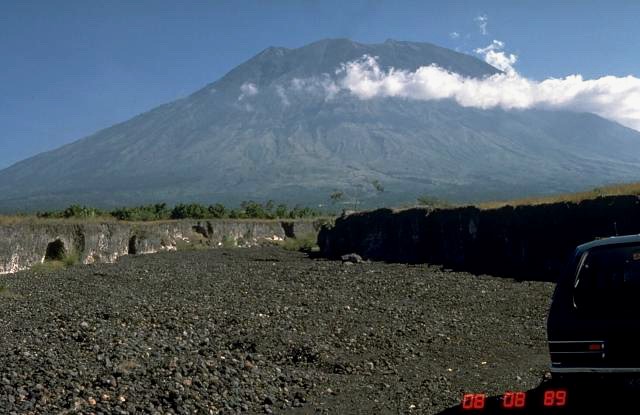
Mount Agung or Gunung Agung is a mountain in Bali, Indonesia. This stratovolcano is the highest point on the island. It dominates the surrounding area, influencing the climate. The clouds come from the west and Agung takes their water so that the west is lush and green and the east dry and barren.
The Balinese believe that Mount Agung is a replica of Mount Meru, the central axis of the universe. One legend holds that the mountain is a fragment of Meru brought to Bali by the 1st Hindus. The most important temple on Bali, Pura Besakih, is located high on the slopes of Gunung Agung.
Mount AgungGunung Agung last erupted in 1963-1964 and is still active, with a large and very deep crater which occasionally belches smoke and ash. From a distance, the mountain appears to be perfectly conical, despite the existence of the large crater.
From the peak of the mountain, it is possible to see the peak of Mount Rinjani on the island of Lombok, although both mountains are frequently covered in clouds.
Mount AgungThe lava flows missed, sometimes by mere yards, the Mother Temple of Besakih. The saving of the temple is regarded by the Balinese people as miraculous and a signal from the gods that they wished to demonstrate their power but not destroy the monument the Balinese faithful had erected.
Guides are available in Besakih and also in Pura Pasar Agung. The mountain can also be climbed without a guide. The climb from Besakih is quite tough. It is sometimes tackled as a single climb generally starting about 10 p.m. for a dawn arrival at the peak and sometimes with an overnight camp about three quarters of the way up. The climb from Pura Pasar Agung generally starts around 2:30 a.m. for a dawn arrival. It is far harder than the more popular Balinese climb up Gunung Batur. It isn't a mountain that needs ropes and not quite high enough for altitude sickness, but adverse weather conditions develop quickly and warm waterproof clothing is required and should be carried. A dawn arrival at the top is recommended in order to avoid clouds that typically cover the top from approximately 9 a.m. onwards. There is no water available along the route.
For the Besakih route proceed through the temple complex then continue on a path that travels continuously upwards on a steep narrow spur through open forest and jungle most of the way. There is little potential to get lost until the route opens up towards the top where the correct route doubles backwards. Many climbers miss this turn and continue up a small valley which can be climbed out of with some difficulty.

Related Sites for Mount Agung

Teluk Cenderawasih National Park is the largest marine national park of Indonesia

Teluk Cenderawasih National Park

Teluk Cenderawasih National Park

Teluk Cenderawasih National Park is the largest marine national park of Indonesia, located in Cenderawasih Bay, south-east of Bird's Head Peninsula. It includes the islands of Mioswaar, Nusrowi, Roon, Rumberpon and Yoop. The park protects a rich marine ecosystem, with over 150 recorded coral species, for which it is considered a potential World Heritage Site.
Extending over 14,535 kmx, the national park includes coastal and mangrove ecosystems, coral reefs (5.5%), island tropical forest ecosystems (3.8%), and marine waters (89.8%). Some 46 species of plant have been recorded on the islands, dominated by Bruguiera and Avicennia species, Nypa fruticans, Metroxylon sagu, Casuarina equisetifolia, and Terminalia catappa.
Teluk Cenderawasih National ParkThe coral reef ecosystem forms part of the Coral Triangle region. In the park, 150 species of coral have been recorded, consisting of 15 families and distributed on the shores of 18 islands. Among these are colonies of blue coral, black coral, Leptoseris species, Mycedium elephantotus, and Alcyonacea or soft corals. The percentage of live coral coverage varies from between 30-40% to 64-65%.
Over 200 fish species inhabit the park, among them butterflyfish, damselfish, parrotfish, rabbitfish, clownfish and sharks. Species of mollusc include cowry, Strombidae, Lambis species, Charonia tritonis, and giant clam.
Four species of turtle are common in the park: the hawksbill turtle, green turtle, Olive Ridley turtle, and leatherback turtle. Mammals include dugong, blue whale and dolphins.
About 14,000 people live in 72 villages within the park. Several Austronesian languages are spoken in the area, which form part of the Cenderawasih languages branch and include: Wandamen, Dusner, Meoswar, Roon and Yeretuar. Most of the park is part of Teluk Wondama Regency of West Papua province, while the eastern part is in Nabire Regency of Papua province.
In 1990, the area was designated as Teluk Cendrawasih Marine Nature Reserve. The National Park was designated in 1993 and declared in 2002. The park is managed by Balai Taman Nasional with a personnel of 106.

Related Sites for Teluk Cenderawasih National Park

Friday, 13 September 2013

Kakaban island : part of the Derawan Islands, East Kalimantan, Indonesia

Kakaban

Kakaban

Kakaban island is part of the Derawan Islands, East Kalimantan, Indonesia.
The most distinctive feature is the huge brackish water lake in the middle of the island, in the local dialect Kakaban means "hug" as the island hugs the lake from the surrounding seawater.
KakabanIn the middle of this island is a mangrove-fringed lake, slightly above sea level, where thousands of non-stinging jellyfish live making it interesting for diving. The jellyfish consist of four different species which have lost their natural defense system because of the lack of major predators in the lake. They are: Aurelia aurita with transparent body, Tripedalia cystophora which only has a tip finger size, Mastigias papua is likes a green-brown bulb, Cassiopea ornata which is upside-down jellyfish with their tentacles upright. Similar lakes exist in the Philippines Palau, with Jellyfish Lake being the best known.
The lake has warm brackish water and the bottom is covered with marine green algae. There are other animals living here, some sea cucumbers, gobies, sea anemones, tunicates, crustaceans, nudibranchs, orange purple clams and yellow clams on the branches, and snakes.

Related Sites for Kakaban

Jimbaran : fishing village and tourist resort in Bali, Indonesia

Jimbaran

Jimbaran

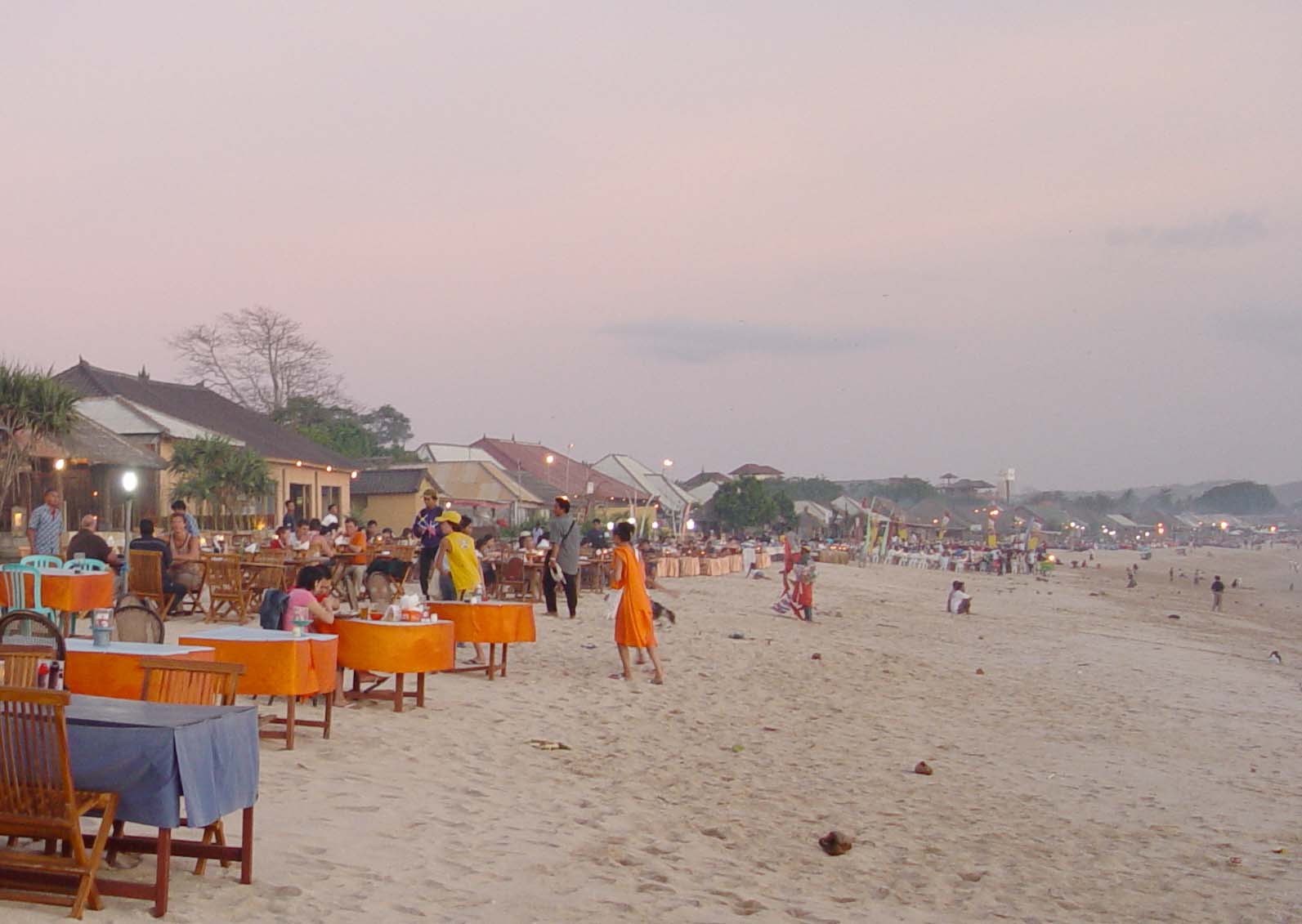
JimbaranJimbaran is a fishing village and tourist resort in Bali, Indonesia. Located south of Ngurah Rai International Airport, the beach has seafood restaurants and luxury hotels, including the five-star Kayumanis Private Estate & Spa, Intercontinental Hotel Bali, Ayana Resort and Spa, Four Seasons and Jimbaran Puri Bali and the casual dinning restaurant Cuca, helmed by award winning Chef Kevin Cherkas, beside the Kayumanis Private Estate & Spa. Tourism in Jimbaran has increased rapidly so that it has boosted the local economy, but was devastated by the 2005 Bali bombings when suicide bombers struck at two popular warungs along the beach. However, the tourism industry has recovered. Diners select the live seafood that they wish to eat, and it is immediately prepared, generally grilled over a fire of coconut husks rather than charcoal.
It is administered under Kuta South District along with Nusa Dua peninsula.
Jimbaran lies on the
peninsula in Bali.
'neck' of the southern
-
The beach, looking tothe south.
Fishing boat landing atJimbaran beach.
Morning catch of marlinat Jimbaran.
Jimbaran Beach.-
Sunset at JimbaranBeach.

Related Sites for Jimbaran

Thursday, 12 September 2013

Purwokerto is a city on the island of Java, Indonesia

Purwokerto

Purwokerto

Purwokerto is a city on the island of Java, Indonesia. It is the capital of Banyumas Regency, Central Java region. The estimated population of the city in 2005 was 249,705.
Purwokerto is located near the base of Mount Slamet, the tallest volcano in Central Java. The city is bisected by the Kali Kranji. It lies near two major east-west roads, Jalan Sudirman and Jalan Gatot Subroto.
The history of Purwokerto as the capital of the Banyumas Regency is intertwined with the history of Banyumas itself. Banyumas was established in 1582 by Raden Joko Kahiman. He later became the came the 1st regent, Duke Mrapat.
Train is one of the main modes of transport to Purwokerto. All classes of ticket, from economy to 1st class, are available for trips on trains from Jakarta, Bandung, Yogyakarta and Surabaya. The total journey from Jakarta is 6 hrs and 10 hrs (economy class).
PurwokertoIntercity buses connect Purwokerto to other cities on the island. The Purwokerto bus terminal is the 3rd largest terminal in Central Java province after Terboyo and Tirtonadi (Surakarta).
Purwokerto's central public square, Indonesian: Alun-alun, has six banyan trees: a tree at each corner, and two in the center. The townsfolk often spend their leisure time in the shady square and it is a common place for children to play. Vendors in the square sell children's toys and local foods. On one side is the regional government building, Kabupaten. On the west side of the square is the Masjid Baitus Salam Mosque of Purwokerto. To the east is the old cemetery on Ragasemangsang Road.
Located in the city center, Bank BRI Museum was built and dedicated for the Bank BRI's founder, R.A. Wiriatmadja. Formerly named as De Purwakertosche Hulp-en Spaar Bank der Inlandsche Bestuur Ambtenaren in 1895, now Bank BRI is one of the largest bank in the nation, as well as the oldest in the nation. Displays a lot of collections of coin and money from the VOC era until present time.
The Purwokerto local food includes mendoan, ranjem, nopia and mino (small nopia), tempeh keripik and many different kinds of chips. Gethuk goreng, made of cassava and Javanese sugar is also available. It is sold by various shops under various names. Also, in the morning, one may find a serabi seller on almost every corner of town. One Purwokerto delicacy is soto. It is also made in the nearby town of Sokaraja. Purwokerto soto is made from chicken while that from Sokaraja contains beef. Both are different from other sotos in Indonesia, because they are mixed with a spicy nut sambal. The most famous soto sokaraja seller in Sokaraja is "Soto Kecik", near the Buddha's monastery.
The main state run hospital is Margono Soekarjo general hospital which is located on the eastern edge of Purwokerto. Its name is commonly shortened to "RS Margono Soekarjo". It was named after the 1st surgeon in Indonesia. The surgeon was born in Purwokerto and his grave is found in Pesarean Kebutuh, Sokaraja Kulon.

Related Sites for Purwokerto

Golkar : a political party in Indonesia

Golkar


The Party of the Functional Groups is a political party in Indonesia. Originally known as Sekber Golkar (Sekretariat Bersama Golongan Karya, or Joint Secretariat of Functional Groups), it was the ruling party from 1966 to 1999, under Suharto's New Order regime (1966-98) and the brief presidency of B. J. Habibie (1998-99). It has been a part of the ruling coalition of President Susilo Bambang Yudhoyono's ruling coalition since 2004.
GolkarIn 1959, President Sukarno introduced his concept of Guided Democracy, in which so-called functional groups would play a role in government in place of political parties. The Army supported this because it believed these groups would balance the growing strength of the Communist Party of Indonesia. In 1960, Sukarno awarded groups such as teachers, the Army, workers and artists seats in the Mutual Cooperation - People's Representative Council. As some of these functional groups were linked to political parties, this gave the army political influence. The Army then established an anti-PKI trade union, the Central Organization of Indonesian Workers, or Soksi (Sentral Organisasi Karyawan Swadiri Indonesia), and used this as the core of an Army-led Joint Secretariat of Functional Groups, or Sekber Golkar, which was officially established on October 20, 1964. By 1968 there were almost 250 organizations under the Sekber umbrella. On November 22, 1969 they were organized into seven main organizations, or Kino (Kelompok Induk Organisasi), namely Soksi, Hosgoro (Union of Mutual Cooperation Multifunction Organizations), MKGR (Mutual Assistance Families Association), Gerakan Karya Rakjat (People's Working Movement), Ormas Hankam (Defense and Security Mass Organizations), Professi (professional organizations), and Gerakan Pembangunan (Development Movement).
In March 1968, General Suharto was officially elected by the People's Consultative Assembly as Indonesia's 2nd president. Because of his military background, Suharto wasn't affiliated to any political parties. Suharto had never expressed much interest in party politics. However, if he were to be elected for a 2nd term as President, he needed to align himself with a political party. Originally, Suharto had shown interest in aligning with the Indonesian National Party (PNI) â€" the party of his predecessor, Sukarno. But in seeking to distance himself from the old regime, Suharto settled on Golkar.
Suharto then ordered his closest associate, Ali Murtopo, to transform Golkar and turn it into an electoral machine. Under Murtopo, and with Suharto's supervision, Golkar was turned from a federation of NGOs into a political party. Under Suharto, Golkar continued to portray itself as a non-ideological entity, without favoritism or political agendas. It promised to focus on "economic development" and "stability" rather than a specific ideological goal. Golkar also began identifying itself with the government, encouraging civil servants to vote for it as a sign of loyalty to the government.
Murtopo claimed that workers were part of a Functional Group, which by rights ought to be subsumed under Golkar: "thus all unions were united into a single body answerable to the state. The population was no longer there to be mobilised by political parties, rather, the people were the 'floating mass', or the 'ignorant mass', who needed firm guidance so they would not be lured into politics. In order to "Golkar-ize" the nation, Murtopo sometimes used the military and gangs of young thugs to eliminate political competition.
Golkar declared on February 4, 1970 that it would be participating in the 1971 legislative elections. Suharto's alignment with Golkar paid dividends when Golkar won 62% of the votes and an overwhelming majority in the People's Representative Council. The members of DPR also doubled as members as MPR and thus Suharto was easily re-elected to a 2nd term as President in March 1973.
The 1971 legislative election was a success for Golkar and Suharto. Strengthened by his re-election, Suharto quickly began tightening his grip on Golkar. Control was increased in October 1973 with the implementation of a less democratic and more centralized system headed by a Chairman. In October 1978, after his re-election to a 3rd term, Suharto further consolidated his control of Golkar by being elected Chairman of the Executive Board, a position whose authority supersedes even the party chairman. From this position, Suharto had the supreme power in Golkar while leaving the day-to-day running of Golkar to the chairman.
Aside from being dominated by Suharto, Golkar was also an organization dominated by the Army. Out of the four people that served as Golkar Chairman during the New Order, three had a military background. It was only in the last years of Suharto's rule that Harmoko, a civilian, was elected as Golkar chairman.
Golkar continued to dominate Indonesian politics well beyond the 1971 legislative elections. In subsequent New Order legislative elections, Golkar won 62%, 64% (1982), 73% (1987), 68% (1992), and 74% (1997). Golkar's dominance was so absolute that for most of the Suharto era, Indonesia was effectively a one-party state. Suharto was able to pass his bills without any meaningful opposition, and =was able to form a Cabinet which consisted only of Golkar appointees.
After 1973, Suharto banned all political parties but for the Indonesian Democratic Party and the United Development Party (PPP). These two parties were nominally permitted to contest the reign of Golkar. In practice, however, Golkar permitted only a semblance of competition. The state controlled the only television station in Indonesia (until 1989, with advent of RCTI), and elections were "exercises in controlled aggression.". Elections were ritualized performances of "choice," in which local authorities were to obey directives about Golkar's electoral results in their area. A system of rewards, punishments, and violence meted out by thugs helped to guarantee cooperation across the archipelago, and the perpetual reelection of Golkar.
After the 1977 and 1997 legislative elections, there were claims of electoral fraud launched by the party, who together with Golkar were the only legal political parties after 1973. There were also claims of Golkar members intimidating the electorate to vote for Golkar.
These three factions work closely together to gain consensus and in the case of nominating a presidential candidate it was the heads of these three factions who went to inform the candidate that he had just been nominated as Golkar's Presidential candidate. The three factions didn't always work together however. In 1988, the ABRI faction was unable to nominate Sudharmono as Vice President. The factions disappeared along with the fall of the New Order.
With Suharto's fall from power in May 1998, Golkar quickly sought to adapt and reform itself. In July 1998, a Special National Congress was held to elect the next Chairman of Golkar. The congress were dogged by protests by both pro-Suharto and anti-Suharto groups. Suharto himself didn't come to the congress. In the contest that followed, Akbar Tanjung emerged as the new Chairman of Golkar after beating Army General Edi Sudrajat. It was the 1st time that a Golkar Chairman was elected democratically rather than appointed by the Chairman of the Executive Board. Under Akbar, the Executive Board was abolished and replaced by an Advisory Board which had considerably less authority.
In 1999, Golkar lost it 1st legislative elections to Megawati Sukarnoputri's PDI-P. Golkar won 20% of the votes and was the runner-up in the legislative elections. Despite losing these elections Golkar was still able to secure the Tanjung's election as Head of DPR. October 1999 would see the MPR assemble for its General Session during which a President and a Vice President would be elected. It was widely expected that Golkar would support Jusuf Habibie in his bid for a 2nd term as President. Before Habibie could be nominated, however, he was required to deliver an accountability speech: a report delivered by the President to the MPR at the end of his term. The MPR would not ratify the accountability speech and it was revealed that some Golkar members had voted against ratifying the speech.
Golkar would get its revenge on PDI-P in the presidential elections. Although PDI-P had won the legislative elections, Golkar joined forces with the Central Axis, a political coalition put together by MPR Chairman Amien Rais, to nominate and successfully secure the election of Abdurrahman Wahid as President. Golkar, however, was unable to stop the election of Megawati as the Vice President.
Golkar was rewarded for its support of Wahid by having its members appointed to ministerial positions in Wahid's Cabinet. Much like those who had supported Wahid, Golkar would grow disillusioned with Wahid. In April 2000, Jusuf Kalla, a Golkar member who held position as Minister of Industries and Trade was sacked from his position. When Golkar inquired as to why this was done, Wahid claimed alleged it was because of corruption. In July 2001, Golkar, along with its Central Axis allies, held an MPR Special Session to replace President Wahid with Megawati.
By 2004, the reformist sentiments that had led PDI-P to victory in the 1999 legislative elections had died down. Many Indonesians were disappointed with what Reformasi had achieved thus far and were also disillusioned with Megawati's Presidency. Such discontent enabled Golkar to emerged victorious in the 2004 legislative elections with 21% of the votes.
Unlike the other political parties who had one person as their presidential candidate from the start, Golkar had five. In April 2004, Golkar held a national convention to decide who would become Golkar's candidate for President. These five were Akbar Tanjung, General Wiranto, Lieutenant-General Prabowo, Aburizal Bakrie, and Surya Paloh. Akbar won the 1st round of elections but Wiranto emerged as the winner in the 2nd round. Wiranto chose Solahuddin Wahid as his running mate.
The Presidential Elections were held on July 5, 2004. The 1st round of elections was won by Susilo Bambang Yudhoyono and Jusuf Kalla who faced Megawati and Hasyim the September 2004 run-off. Wiranto/Wahid came 2nd and there were allegations of disunity within the party with Akbar not fully supporting Wiranto after losing the nomination.
In August 2004 Golkar formed, with PDI-P, PPP, Reform Star Party and Prosperous Peace Party (PDS), a national coalition to back Megawati. Further infighting would hamper Golkar in its bid to back Megawati. Fahmi Idris led a group of Golkar members in defecting and threw their support behind Yudhoyono and Kalla. At the Presidential Run-Off in September 2004, Yudhoyono emerged victorious over Megawati to become Indonesia's 6th President. Jusuf Kalla, who had gone his own way back in April 2004, became Vice President.
Although he had overwhelmingly won the Presidency, Yudhoyono was still weak in the DPR. His own Democratic Party had only won 7% in the Legislative Elections and even combined with other parties who had aligned themselves with the new Government, they still had to contend with the Legislative muscles of Golkar and PDI-P who now intended to play the role of opposition.
With a National Congress to be held in December 2004, Yudhoyono and Kalla had originally backed Head of DPR Agung Laksono to become Golkar Chairman. When Agung was perceived to be too weak to run against Akbar, Yudhoyono and Kalla threw their weight behind Surya Paloh. Finally, when Paloh was perceived to be to weak to run against Akbar, Yudhoyono gave the green light for Kalla to run for the Golkar Chairmanship.
This was a widely controversial move. Up to that point, Yudhoyono had not let members of his administration hold a concurrent position in political parties to prevent the possible abuse of power. There was also complains by Wiranto who claimed that some months earlier, Yudhoyono had promised to support him if he runs for the Golkar Chairmanship.
On December 19, 2004, Kalla became the new Golkar Chairman with over 50% of the votes. Akbar, who had expected to win a 2nd term as Golkar Chairman was defeated with 30% of the votes. Agung and Surya, who Yudhoyono and Kalla had backed earlier, became the Party Vice Chairman and the Chairman of the Advisory Board, respectively.

Related Sites for Golkar

  • Ali Golkar read Golkar
  • Indonesia - Golkar - Country Studies read Golkar
  • Healthgrades - Dr. Linda Golkar - Phone & Address Info - Yorba ... read Golkar
  • Dr. Linda Golkar, MD :: Dermatologist in Loma Linda, CA read Golkar