Showing posts with label North Sumatra. Show all posts

Wednesday, 9 July 2014

Karo people

Karo people

Karo peopleThe Karo, or Karonese, are people of the 'tanah Karo' of North Sumatra and a small part of neighbouring Aceh. The Karo lands consist of Karo Regency, plus neighbouring areas in East Aceh Regency, Langkat Regency, Dairi Regency, Simalungun Regency and Deli Serdang Regency. In addition, the cities of Binjai and Medan, both bordered by Deli Serdang Regency, contain significant Karo populations, particularly in the Padang Bulan area of Medan. The town of Sibolangit, Deli Serdang Regency in the foothills on the road from Medan to Berastagi is also a significant Karo town.
Karoland contains two major volcanoes, Mount Sinabung, which erupted after 400 years of dormancy in 2010, and Mount Sibayak. Karoland consists of the cooler high lands, and the upper and lower lowlands.
The Karolands were conquered by the Dutch in 1906, and in 1909 roads to the highlands were constructed, ending the isolation of the highland Karo people. The road linked Medan and the lowlands to Kabanjahe and from there to both Kutacane in Aceh and Pematangsiantar in Simalungun.
Karo peopleIn 1911, an agricultural project began at Berastagi, now the major town in Karoland, to grow European vegetables in the cooler temperatures. Berastagi is today the most prosperous part of Karoland, just one hour from Medan, while towns further in the interior suffer from lower incomes and limited access to healthcare.
The administrative
Kabanjahe.
centre of Karo Regency is
-
The Karo people speak the Karo language, a language related to, but not mutually intelligible with, other Batak languages, in addition to Indonesian. These Karo people are divided up into clans or Merga. The Karo Merga are Ginting, Karo-Karo, Perangin-Angin, Sembiring and Tarigan, these Merga are then divided up into families.
Karo people religion are mostly Christian, a religion brought to Sumatra in the 19th Century by missionaries, but an increasing number living away from the Karo Highlands have converted to Islam, with the influence of Muslim Javanese and Malay peoples making the traditional habits of pig farming and cooking less common. Some Muslims and Christians however still retain their traditional animist beliefs in ghosts, spirits, and traditional jungle medicine, despite that fact it contradicts their other beliefs.
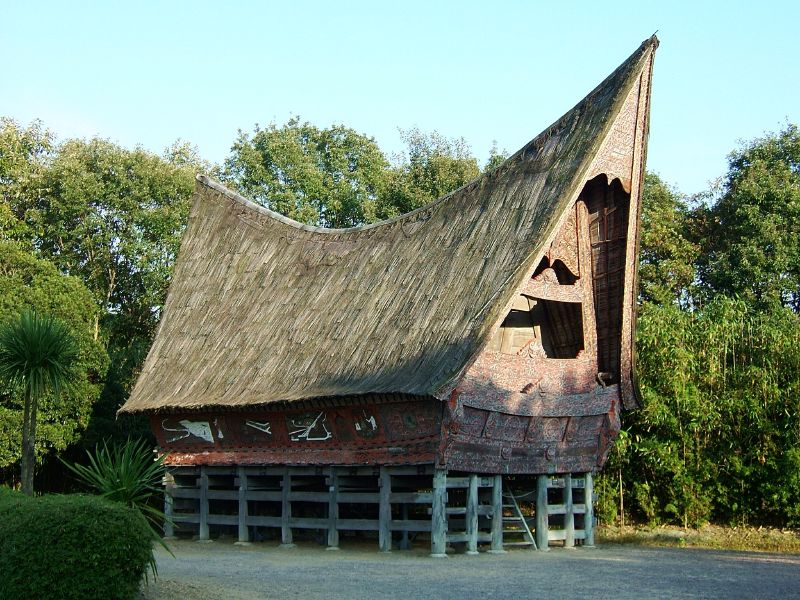
Karo people traditionally lived in shared longhouses, but very few now remain, and new construction is exclusively of modern designs.
It is believed that Karo people may have migrated from the other lands in order to take part in trade with the visiting Tamils. This intercourse had an influence on their religious beliefs, as well as ethnic makeup, the marga 'Sembiring', meaning 'black one', and many Sembiring sub-marga are clearly of South-Indian origin, suggesting that inter-marriage between Karo and Indian people took place.
The Karo were harassing Dutch interests in east Sumatra, and Jacob Theodoor Cremer, a Dutch administrator, regarded evangelism as a means to suppress this activity. The Netherlands Missionary Society answered the call, commencing activities in the Karolands in 1890, where they engaged not only in evangelism, but also in ethnology and documenting the Karo culture. The missionaries attempted to construct a base in Kabanjahe in the Karo highlands, but were repelled by the suspicious locals.
In retaliation the Dutch administration waged a war to conquer the Karolands, as part of their final consolidation of power in the Indies. The Karo perceived Christianity as the 'Dutch religion', and its followers as 'dark-skinned Dutch'. In this context, the Karo church was initially unsuccessful, and by 1950 the church had only 5,000 members. In the years following Indonesian independence the perception of Christianity among the Karo as an emblem of colonialism faded, with the church itself acquiring independence, and adopting more elements of traditional Karo culture such as music. By 1965, the Karo church had grown to 35,000 members.
Unlike the Toba Batak, who embraced Christianity fairly readily, the Karo continued to follow their traditional religion for several decades after the arrival of the 1st Christian missionaries in the Karolands.
Following the Indonesian Genocide in 1965-1966, at which time over 70% of the Karo still followed traditional religions, there was a push for Indonesians to identify with an established religion. Many Karo joined the GBKP (60,000 were baptised in 1966-1970.), and from 5,000 Muslims (mostly non-Karo) in Karoland in 1950, there were 30,000 in 1970.
At this time, the Balai Pustaka Adat Merga Si Lima was established in Berastagi. BPAMSL, proclaimed the 'agama Pemena', or the religion (agama) of the founders (Pemena).
The concept of 'religion' was relatively new in the Karoland; historically the neighbouring Muslim people, were known as 'kalak Jawi' or the people of the Jawi lands, and the concept of 'kalak Kristen', or Christian people, was the 1st time that people were identified by their religion rather than their land. The 'agama Pemena' of BPAMSL was a defence against accusations of atheism, Communism or animism.
BPAMSL conducted a ceremony in the Lau Debukâ€"Debuk hot spring akin to the one to invest a new Karo village. This ceremony essentially validated the Dutch-established Berastagi as a 'true' Karo village, and was attended by the regent of Karo regency and other political figures.
At that time, BPAMSL became the largest religious organisation in the Karolands, surpassing the GBKP, and absorbing many who had joined it following the anti-Communist purge.
As a response to the Pemena movement, the GBKP after 1969 determined that members could participate in village rituals as a matter of adat, whereas previously they had been rejected by GBKP as of a religious (unchristian) nature.
After Golkar won the elections in 1972, Djamin Ginting, a leading BPAMSL figure proclaimed BPAMSL as a movement within Golkar, adopting Islam as his religion, while Indonesian National Party supporters rejected this. With BPAMSL no longer a united force for the practice of Pemena, and Pemena itself no longer a uniting force in the Karoland, and with all Indonesians required to follow one of the religions of Islam, Protestantism, Catholicism, Hinduism and Buddhism, or risk writing 'without belief' on their identity card, the board members of BPAMSL met with a wealthy Indian man from Medan and determined that the traditional religion was in fact an expression of Indian Hinduism, and that it had been founded by a 'Bagavan Bá¹›gu', from which had been derived the alternate name for the Karo beliefs 'Perbegu' ), the existence of Indian-originating Karo marga names and similarities between Karo ritual and Indian Hindu ones all proving this. Thus the Association of Karo Hinduism (PAHK) was proclaimed.
The PAHK declared 'Pemena is the same as Hinduism' and received funding from Medan Indians for their cause. PAHK became a movement within Parisada Hindu Dharma Indonesia, and as a culmination of this, in 1985 PAHK became a branch of the PHDI, PHDK. When Parisada Hindu Dharma Karo was established, it claimed 50,000 members, and 50,000 more sympathisers. The PHD built a Balinese-style temple in Tanjung, a Karo village to inaugurate the PHDK. In doing so it was stated that PHDI (i.e. Balinese) Hinduism was the only valid form, and in fact the Karo 'Hindu' ritual were invalid, the name change from 'Hindu Karo' to 'Hindu Dharma Karo' and the replacement of Tamil Indians on the PAHK board with Balinese on the PHDK symbolising the assertion of 'Hindu Dharma' as the 'valid' Hindu religion, with little regard paid to re-imagining Karo rituals within an Agama Hindu context.
There was an immediate decline in PAHK/PHDK support, with a small number of people still following the PHDK practices, but others following traditional Karo rituals outside of the formal context of PHDK. This left the Christian GBKP, by then for many years an indigenous Karo-run adat-respecting church a rather more comfortable option for most Karo than the Balinese Hinduism asserted by PHDK. There are today four Balinese-style PHDK temples in the Karoland, but the concept of Karo traditional beliefs as a manifestation of Hinduism is otherwise largely extinct.
Although the Gereja Batak Karo Protestan is the largest Karo church, with has 276,000 members (as of 2006) in 398 congregations with 196 pastors, there are also Catholic (33,000 members as of 1986) and several Pentecostalist denominations.
Karo people belong to one of five marga or clans, which are Ginting, Karo-Karo, Perangin-Angin, Sembiring and Tarigan. Each marga is further divided into sub-marga. With the exception of marga Karo-Karo, most Karo identify themselves by their principal rather than sub-marga.
Karo and Batak adat prohibits marriage within a marga. Upon marriage, the bride becomes a part of the groom's family, with the kalimbubu (bride's family) joining with anakberu (groom's family).

Related Sites for Karo people

Saturday, 28 September 2013

Batak in North Sumatra, Indonesia

Batak

Batak
Batak is a collective term used to identify a number of ethnic groups predominantly found in North Sumatra, Indonesia. The term is used to include the Alas, Kluet, Singkil, Karo, Pakpak, Simalungun, Toba, Angkola, and Mandailing which are distinct but related groups with distinct, albeit related, languages and customs.
In North Sumatra, Toba people typically assert their identity as 'Batak', while other 'Bataks' may explicitly reject that label, preferring instead to identify as specifically 'Simalungun', 'Karo', etc.
BatakLinguistic and archeological evidence indicates that Austronesian speakers 1st reached Sumatra from Taiwan and the Philippines through Borneo and/or Java about 2,500 years ago, and the Batak probably evolved from these settlers. While the archaeology of southern Sumatra testifies the existence of neolithic settlers, it seems that the northern part of Sumatra was settled by agriculturalists at a considerably later stage.
Although the Batak are often considered to be isolated peoples, largely because they were inland, away from influence by seafaring European colonials, there is evidence that they have been involved with trade and contact with other neighbouring kingdoms for a millennium or more. Reliable historical records of the Batak before 1800 are almost non-existent. The Bata were possibly documented in Zhao Rugua's 13th-century Description of the Barbarous People, which refers to a 'Ba-ta' dependency of Srivijaya. The Suma Oriental, of the 15th century, refers to the kingdom of Bata, bounded by Pasai and the Aru kingdom.
The Bataks were likely involved with trade with Srivijaya for benzoin and camphor, both of which were important commodities for trade with China, and grew in the Batak lands of northwest Sumatra, perhaps from the eighth or ninth centuries, and continuing for the next thousand years, Batak men carrying the products on their backs for sale at ports.
It is suggested that the important port of Barus in Tapanuli was populated primarily by Batak people. A Tamil inscription has been found in Barus dated 1088, while contact with Chinese and Tamil traders took place at Kota Cina, a trading town located in what is now northern Medan that was established in the eleventh century, and comprising 10,000 people by the twelfth century. Tamil remains have been found on key trade routes to the Batak lands.
These trading opportunities may have caused migration of Batak from Pakpak and Toba to the present-day Karo and Simalungun 'frontier' lands, where they were exposed to greater influence from visiting Tamil traders, while the migration of Batak to the Angkola-Mandailing lands may have been prompted by eighth-century Srivijayan demand for camphor.
The Karo marga or tribe Sembiring "black one" is believed to originate from their ties with Tamil traders, with specific Sembiring sub-marga, namely Brahmana, Colia, Pandia, Depari, Meliala, Muham, Pelawi, and Tekan all of Indian origin. Tamil influence on Karo religious practices are also noted, with the pekualuh secondary cremation ritual specific to the Karo and Dairi people.
From the sixteenth century onwards, Aceh increased the production of pepper, an important export commodity, and in doing so needed to import rice, which grew well on the Batak wetlands. Batak people in different areas cultivated either sawah "wet rice fields" or ladang "dry rice", and the Toba Batak, most expert in agriculture, would have migrated to meet demand in new areas. The increasing importance of rice had religious significance, increasing the power of the Batak high priests, who had responsibility for ensuring agricultural success.
Batak speak a variety of closely related languages, all members of the Austronesian language family. There are two major branches, a northern branch comprising the Pakpak-Dairi, Alas-Kluet and Karo languages, which are similar to each, and a distinctly different southern branch, comprising three mutually intelligible dialects: Toba, Angkola and Mandailing. Simalungun is an early offspring of the southern branch. Some Simalungun dialects can be understood by speakers of Batak Karo, whereas other dialects of Simalungun can be understood by speakers of Toba. This is due to the existence of a linguistic continuum that often blurs the lines between the Batak dialects. Batak dialect still influences the dialects in Medan city until now.
The Batak possess their own script known as the Surat Batak. The writing has chiefly ceremonial importance within traditional religious ceremonies, and was subject to little change for this reason. It is likely that the Batak people originally received their writing system from southern Sumatra.
Batak societies are patriarchally organized along clans known as Marga. A traditional belief among the Toba Batak is that they originate from one ancestor "Si Raja Batak", with all Margas descended from him. A family tree that defines the father-son relationship among Batak people is called tarombo. In contemporary Indonesia, Batak people have a strong focus on education and a prominent position in the professions, particularly as teachers, engineers, doctors and lawyers. Toba Batak are known traditionally for their weaving, wood carving and especially ornate stone tombs.
Before they became subjects of the colonial Dutch East Indies government, the Batak had a reputation for being fierce warriors. Today the Batak are mostly Christian with a Muslim minority. Presently the largest Christian congregation in Indonesia is the HKBP Christian church. The dominant Christian theology was brought by Lutheran German missionaries in the 19th century, including the well-known missionary Ludwig Ingwer Nommensen. Christianity was introduced to the Karo by Dutch Calvinist missionaries and their largest church is the GBKP (Gereja Batak Karo Protestan). The Mandailing and Angkola Batak were converted to Islam in the early 19th century. A significant minority of Batak people don't adhere to either Christianity or Islam, however, and follow traditional practices known as the agama si dekah, the old religion, which is also called perbegu or pemena.
The Venetian Niccolx de' Conti spent most of 1421 in Sumatra in the course of a long trading journey to Southeast Asia (1414â€"1439), and wrote a brief description of the inhabitants: "In a part of the island called Batech live cannibals who wage continual war on their neighbors.".
Sir Thomas Stamford Raffles in the 1820s studied the Batak and their rituals and laws regarding the consumption of human flesh, writing in detail about the transgressions that warranted such an act as well as their methods. Raffles stated that "It is usual for the people to eat their parents when too old to work," and that for certain crimes a criminal would be eaten alive: “The flesh is eaten raw or grilled, with lime, salt and a little rice.”.
Junghuhn tells how after a perilous and hungry flight he arrived in a friendly village, and the food that was offered by his hosts was the flesh of two prisoners who had been slaughtered the day before, however he maintains that the Batak exaggerated their love of human flesh in order to frighten off would-be invaders and to gain occasional employment as mercenaries for the coastal tribes who were plagued by pirates.
Oscar von Kessel visited Silindung in the 1840s and in 1844 was probably the 1st European to observe a Batak cannibalistic ritual in which a convicted adulterer was eaten alive. Interestingly, his description parallels that of Marsden in some important respects, however von Kessel states that cannibalism was regarded by the Batak as a judicial act and its application was restricted to very narrowly defined infringements of the law including theft, adultery, spying or treason. Salt, red pepper and lemons had to be provided by the relatives of the victim as a sign that they accepted the verdict of the community and were not thinking of revenge.
Dutch and German missionaries to the Batak in the late 19th century observed a few instances of cannibalism and wrote lurid descriptions to their home parishes in order to raise donations. The growing Dutch influence in northern Sumatra led to increased Malay influence in coastal trade and plantations, pushing the Karo farther inland. Growing ethnics tensions culminated in the 1872 Karo Rebellion where the Karo were suppressed by Dutch and Malay forces. Despite this, Karo resistance to Dutch imperialism lingered into the early twentieth century. In 1890 the Dutch colonial government banned cannibalism in the regions under their control. Rumors of Batak cannibalism survived into the early 20th century but it seems probable that the custom was rare after 1816, due partially to the influence of Islam.
The Batak lands consist of North Sumatra province, excluding Nias island and the historically Malay kingdoms of the East coast. In addition, part of the Karo lands extend into modern-day East Aceh Regency in Aceh province, while parts of the Mandailing lands lie in Rokan Hulu Regency in Riau. Significant numbers of Batak have migrated in recent years to prosperous neighbouring Riau province.
To the south of North Sumatra are the Muslim Minangkabau of West Sumatra, while to the north there are various Muslim Acehnese peoples.
The various Batak cultures differ in their pre-colonial religious ideas as they do in many other aspects of culture. Information about the old religious ideas of the Mandailing and Angkola in southern Batakland is incomplete, and very little is known about the religion of the Pakpak and Simalungun Batak. For the Toba and Karo on the other hand the evidence in the writings of missionaries and colonial administrators is relatively abundant. Information on the traditional forms of Batak religion is derived mainly from the writings of German and Dutch missionaries who became increasingly concerned with Batak beliefs towards the end of the 19th century.
Various influences affected the Batak through their contact with Tamil and Javanese traders and settlers in southern Batakland, and the east and west coast near Barus and Tapanuli, in particular the large Padang Lawas temple complex in Tapanuli. These contacts took place many centuries ago and it is impossible to reconstruct just how far the religious ideas of these foreigners were adopted and reworked by the Batak. It is suggested that the Bataks adopted aspects of these religions, specifically Mahayana Buddhist, Shaivist, and Tantrist practices within their own customs.
The modern Indonesian state is founded on the principles of pancasila, which requires the belief in 'one and only God', the practice of either Protestantism, Catholicism, Islam, Buddhism or Hinduism, one of which must be entered on an individual's KTP. Traditional religions aren't officially recognised, and accordingly traditional religions are increasingly marginalised, although aspects of the traditional Batak religion are still practised alongside Christianity, and, to a lesser extent, Islam.
There are many different versions in circulation. These were formerly passed down through oral tradition but have now been written down in the local languages. There are also large collections of Batak tales collected by European scholars since the mid-19th century and recorded in European languages, mostly Dutch.

Related Sites for Batak

  • Batak on Facebook | Facebook read Batak
  • Suku Batak - Wikipedia bahasa Indonesia, ensiklopedia bebas read Batak

Tuesday, 17 September 2013

North Sumatra is a province of Indonesia

North Sumatra

North Sumatra


North Sumatra is a province of Indonesia. It is located on the island of Sumatra its capital is Medan. It is the most populous Indonesian province outside of Java, with over 13 million inhabitants.
North Sumatra recorded a population of 12,985,075 in the 2010 national census, with a sex ratio of 99.59 men per 100 women.
Sumatra Mandheling and Sumatra Lintong coffee beans are grown in North Sumatra and largely exported to the United States. Mandheling is named after the similarly spelt Mandailing people located in North Sumatra, Indonesia. The name is the result of a misunderstanding by the 1st foreign purchaser of the variety, and no coffee is actually produced in the "Mandailing region". Lintong on the other hand, is named after the Lintong district, also located in North Sumatra.
Besides Lake Toba and Orang Utan conservatory at Bukit Lawang there are also Taman Hutan Raya at Berastagi which declared by Keputusan Presiden RI Nomor 48 Tahun 1998 tanggal 19 November 1998.
The modern Kuala Namu International Airport is opened in July 25, 2013 and located almost 40 kilometers from Medan. The airport replaces the old Polonia International Airport.
North Sumatra has an international seaport at Belawan, near Medan and is now preparing to have a new seaport at Kuala Tanjung, in Batubara regency, for about Rp.1 trillion budget.
Sei Mangkei Industrial Area is known also as Sei Mangkei - Integrated Sustainable Palm Oil Cluster ; it is located in Simalungun Regency and was formally opened on 12 June 2010. Four companies have joined in this area, with investment costs totalling up to Rp1.5 trillion ($176 million). In April 2011, three other companies also joined in the Sei Mangkei area. They are Procter & Gamble Co for making CPO derivatives of cosmetic raw materials, Ferrostaal AG and Fratelli Gianazza SpA.
North Sumatra is currently subdivided into 25 regencies and 8 autonomous cities, listed below with their populations at the 2010 Census. With proposals under consideration to create three additional provinces from parts of North Sumatra, these are grouped below according to the region in which they are situated within the present province.
All parties in the North Sumatra legislative council have agreed to the formation of a new Tapanuli Province, a new Southeast Sumatra Province and a new Nias Island Province. This has been approved at a regional plenary session on 2 May 2011, but still needs approval from Central government which has not enacted the grand design for additional provinces.
The remaining regencies and cities currently within North Sumatra province would comprise the residual area, which would be renamed East Sumatra.

Related Sites for North Sumatra

Tuesday, 10 September 2013

University of HKBP Nommensen, Medan and Pematangsiantar, North Sumatra

University of HKBP Nommensen

University of HKBP Nommensen


Universitas HKBP Nommensen or UHN is a private university with campuses located in Medan and Pematangsiantar, North Sumatra, Indonesia. The university is affiliated with the Batak Christian Protestant Church (Indonesian: Huria Kristen Batak Protestan or HKBP) and is named after the German missionary Ludwig Ingwer Nommensen from the Rhenish Missionary Society.
The idea for a university was 1st floated during the 1952 General Synod of the HKBP. After two years of preparation, the university was inaugurated in the premises of the former Pantoan Hospital in the highland town of Pematangsiantar on 7 October 1954 with three faculties; Law, Economics, and Theology; and an enrolment of 36 students.
The faculty was established in 1961 and offers study programs in Public Administration, Business Administration, and Secretarial Studies. All the study programs have been accredited B by the BAN-PT.
The faculty was established in 1962 and offers study programs in Education and Pedagogic Studies with the following concentrations; English language, Indonesian, Mathematics, and Physical Education. All study programs have been accredited B by BAN-PT.
The faculty was established in 1975 and offers study programs in Civil Engineering, Mechanical Engineering, and Electronic Engineering. All the study programs have been accredited C by the BAN-PT.
The faculty was established in 1976 and offers study programs in Livestock Production, Livestock Nutrition and Fishery Cultivation. This study program has been accredited C by BAN-PT.
The faculty was established in 1984 and offers study programs in Agronomy, Terralogy, Agricultural Economic Sociology, and Agricultural Technology. All study programs have been accredited B and C by BAN-PT.
The faculty was established in 1987 and offers study programs in the English Language and Music.The music major has been accredited B by BAN-PT and the English Language major has also been accredited C by BAN-PT.
The faculty was established in 2001 and offers a single study program in Psychology.This study program has been accredited C by BAN-PT.
The faculty was established in 2003 and offers two study programs: Master of Management and Master Education and pedagogic in English language.
The faculty was established in 1962 and offers study programs in Education and Pedagogic Studies with the following concentrations; English language, Indonesian, German language, Accountancy, Civics Education, Christian Studies, Mathematics, and Physical Education.

Related Sites for University of HKBP Nommensen