Indonesian legislative election, 1955

The 1st elections were originally planned for January 1946, but because the Indonesian National Revolution was still underway, this wasn't possible. After the war, every cabinet had elections in its program. In February 1951 the Natsir cabinet introduced an election bill, but the cabinet fell before it could be debated. The next cabinet, led by Sukiman did hold some regional elections Finally, in February 1952, the Wilopo cabinet introduced a bill for voter registration. Discussions in the People's Representative Council didn't start until September because of various objections from the political parties. According to Feith, there were three factors. Firstly, legislators were worried about losing their seats; secondly they were worried about a possible swing to Islamic parties and thirdly an electoral system in accordance with the Provisional Constitution of 1950 would mean less representation for regions outside Java. Given the fact that cabinets had fallen after introducing controversial measures, there was reluctance to introduce an election bill and there were concerns about possible political conflicts caused by electioneering. However, many political leaders wanted elections as the existing legislature was based on a compromise with the Netherlands and as such had little popular authority. They also believed elections would bring about greater political stability. The "17 October 1952 affair", when armed soldiers in front of the palace demanded dissolution of the legislature, led to greater demands from all parties for early elections. By 25 November, an elections bill had been submitted to the People's Representative Council. After 18 weeks of debate and 200 proposed amendments, the bill passed on 1 April 1953 and became law on 4 April. It stipulated one member of the legislature for 150,000 residents and gave the right to vote to everybody over the age of 18, or who was or had been married. Once the bill had passed the cabinet began appointing members of the Central Electoral Committee. This was to have one member from each government party and an independent chairman. However, the Indonesian National Party (PNI) protested that they had no members on the committee, and this dispute was still unresolved when the cabinet fell on 2 June.
On 25 August 1953, the new prime minister, Ali Sastroamidjojo, announced a 16-month schedule for elections starting from January 1954. On 4 November the government announced a new Central Electoral Committee chaired by PNI member S. Hadikusomo and including all the parties represented in the government, namely Nahdatul Ulama, the Indonesia Islamic Union Party (PSII) the Indonesia People's Party (PRI), the National People's Party (PRN), the Labor Party and the Indoneisan Peasant Front (BTI), as well as the government-supporting Islamic Educators Association (Perti) and the Indonesian Christian Party (Parkindo).
According to Feith, the 1st phase of the election campaign began on 4 April 1953 when the election bill passed into law, and the 2nd phase when the Central Electoral Committee approved the party symbols on 31 May 1954.
At the time the bill passed into law, the cabinet was a coalition of the Islamic Masjumi and nationalistic PNI. The next two cabinets were coalitions led by one of these parties with the other in opposition. Therefore, the main campaign issue was the debate between these two over the role of Islam in the state. Masjumi denied aiming for an Islamic state, while the PNI emphasized their pro-Pancasila stance wasn't anti-Islam. The two other main Islamic parties, the NU and the PSII supported Masjumi in this debate. A 3rd factor was the Communist Party of Indonesia, which campaigned on issues of poverty and the poor lot of the people due to the continued imperialist nature of cabinet policy. Masjumi tried to draw a clear line between the PKI and other parties, accusing it of being a tool of Moscow.
Party programs were rarely discussed during the campaign. Party symbols with or without slogans were displayed on streets in towns and villages, on private homes, public buildings, buses, trees and calendars. The PKI made extraordinary efforts to promote its symbol, displaying it everywhere to make sure people didn't forget it. The PKI campaign was based around social activities such as organizing tool sharing for farmers and building irrigation channels. The party was looking beyond the election to build a permanent basis of support.
In the last few months of the campaign, the major parties focused on educating voters in areas where they had managed to establish village-level organization. This phase included persuasion and threats.
All through September, party leaders were constantly traveling around the country. Daily party newspapers were printed in increasing numbers and given away for free. Articles in dailies these attacked rival parties. In the villages, the emphasis shifted from large rallies to small meetings and house-house canvassing.
Although in April 1954 the Central Electoral Committee had announced that the election would be held on 29 September the following year, by July and early August, preparations had fallen behind schedule The appointment of members of polling station committees planned to start on 1 August didn't begin in many regions until 15 September. In his independence day address on 17 August, President Sukarno said that anybody putting obstacles in way of elections was a "traitor to the revolution". On 8 September, the information minister said that elections would be held on September 29 except in a few areas where preparations were not complete. Eventually, as a result of "feverish activity", polling station committees were ready on election day.
In the run up to polling day, rumors spread, including a widespread poisoning scare in Java. There was also hoarding of goods. In many parts of country there was a spontaneous and unannounced curfew for several nights before polling day.
On polling day itself, many voters were waiting to cast their ballot by 7 am. The day was peaceful as people realized nothing bad was going to happen. A total of 87.65% of voters cast a valid vote and 91.54% voted. Allowing for deaths between registration and polling, only about 6% didn't vote.
The election was a major success for the NU, which saw its number of seats in the People's Representative Council increase from 8 to 45. A surprise was the poor showing of Masyumi, the Socialist Party and Murba. There was a large gap between the "big 4" and the rest of the parties, but contrary to expectations, the number of parties actually increased - there were now 28 with seats in the legislature as opposed to 20 before the election, with the largest party holding only 22% of seats.
The distribution of votes was uneven across the country. The PNI won 85.97% of its vote in Java, the NU 85.6% and the PKI 88.6%, despite the fact that only 66.2% of the population lived on Java. Conversely only 51.3% of Masjumi's vote came from Java, and it established itself as the leading party for the one-third of people living outside Java.
The poor showing of the parties in the cabinet of Prime Minister Burhanuddin Harahap was a major blow. The parties who did better, such as the NU and the PSII were "reluctant" cabinet members with a weak standing. This left the government with the choice of making major concessions to the NU and PSII or seeing them leave the cabinet. With no clear electoral verdict, it was back to inter-party politicking and bargaining. The lack of a clear outcome discredited the existing political system.
The new People's Representative Council convened on 4 March 1956. It was to last four years. In his opening speech, President Sukarno called for an Indonesian form of democracy, and over the next few years, he would speak more about his concept of a new system of government. In 1957, the era of Liberal Democracy came to an end with the establishment of Guided Democracy. Indonesia would have to wait until 1999 for its next free national elections.
Related Sites for Indonesian legislative election, 1955
- Indonesian legislative election, 1955 - Shopping-enabled … read Indonesian legislative election, 1955
- Indonesian legislative election, 1955 - Wikipedia, the free ... read Indonesian legislative election, 1955
- 1955 Elections: Indonesian Legislative Election, 1955, Brazilian ... read Indonesian legislative election, 1955
- List of elections in 1955 - Wikipedia, the free encyclopedia read Indonesian legislative election, 1955
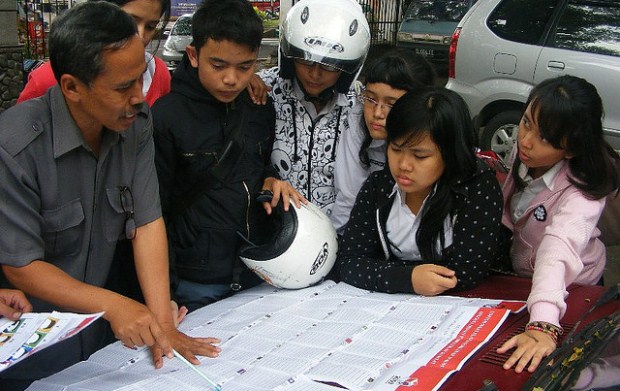
 A total of 46 parties registered to take part in the election, and these will now be verified by the General Elections Commission to ensure they meet the requirements, which are stricter than in previous elections. They include representation in every Indonesian province and a 30 percent female membership. Initially all parties with seats in the People's Representative Council were to be allowed to contest the election without the need for verification, but on 29 August 2012, Indonesia's Constitutional Court overturned this provision, obliging all parties to undergo the process.


