Showing posts with label East Java. Show all posts

Friday, 13 September 2013

Penataran : the largest Hindu temple complex in East Java

Penataran

Penataran
Penataran
Penataran or Panataran is the largest Hindu temple complex in East Java, Indonesia, located roughly 10 km north of Blitar. Believed to have been under construction from the 12th Century to the 15th Century, the temple played a significant role in the Majapahit Kingdom, especially under King Hayam Wuruk.
PenataranPenataran was believed to be dated back to Kediri era. This temple was identified in Nagarakretagama as Palah temple and reported being visited by King Hayam Wuruk during his royal tour across East Java.
The site is being considered to be put on the World Heritage list of sites that have "outstanding universal value" to the world.
This site was added to the UNESCO World Heritage Tentative List on October 19, 1995 in the Cultural category.

Related Sites for Penataran

Mount Bromo, East Java

Mount Bromo

Mount Bromo
Depending on the degree of volcanic activity, the Indonesian Centre for Vulcanology and Disaster Hazard Mitigation sometimes issues warnings against visiting Mount Bromo.
Mount BromoMount BromoOn the fourteenth day of the Hindu festival of Yadnya Kasada, the Tenggerese people of Probolinggo, East Java, travel up the mountain in order to make offerings of fruit, rice, vegetables, flowers and sacrifices of livestock to the mountain gods by throwing them into the caldera of the volcano. The origin of the ritual lies in the 15th century legend where a princess named Roro Anteng started the principality of Tengger with her husband, Joko Seger. The couple were childless and therefore beseeched the assistance of the mountain gods. The gods granted them 24 children but stipulated that the 25th child, named Kesuma, must be thrown into the volcano as a human sacrifice. The gods' request was implemented. The tradition of throwing sacrifices into the volcano to appease these ancient deities continues today and is called the Yadnya Kasada ceremony. Though fraught with danger, some locals risk climbing down into the crater in an attempt to recollect the sacrificed goods that they believe could bring them good luck.
On the Segara Wedi sand plain sits a Hindu temple called Pura Luhur Poten. The temple holds a significant importance to the Tenggerese scattered across the mountain villages, such as Ngadisari, Wonokitri, Ngadas, Argosari, Ranu Prani, Ledok Ombo and Wonokerso. The temple organises the annual Yadnya Kasada ceremony which lasts for about one month. On the 14th day, the Tenggerese congregate at Pura Luhur Poten to ask for blessings from Ida Sang Hyang Widi Wasa and the God of Mahameru. Then the crowd proceeds along the crater edges of Mt Bromo where offerings are thrown into the crater. The major difference between this temple and Balinese ones are the type of stones and building materials. Pura Luhur Poten uses natural black stones from volcanoes nearby, while Balinese temples are mostly made from red bricks. Inside this pura, there are several buildings and enclosures aligned in a mandala zone composition.
Mount Bromo erupted in
led to the death of two
2004. That eruptive episode
people.
On Tuesday, 23 November 2010, 16.30 WIB, the Indonesian Centre of Vulcanology and Geology Hazard Mitigation (CVGHM) confirmed the activity status of Mount Bromo at "alert" due to increasing tremor activity and shallow volcanic earthquakes at the mountain. Concerns were raised that a volcanic eruption might be likely to occur. As a precaution local residents and tourists were instructed to remain clear of an area within a radius of three kilometres from the caldera and refugee encampments were erected. The area surrounding the Teggera caldera of Bromo remained off-limits for visitors throughout the remaining part of 2010.
Bromo started to erupt
2010.
ash on Friday 26 November
-
The Tengger Caldera was still active in late January 2011, the activity being characterised by fluctuating ongoing eruptions. On 23 January 2011 the Indonesian Centre for Volcanology and Geological Hazard Mitigation (Pusat Vulkanologi dan Mitigasi Bencana Geologi) reported that since 19 December 2010 volcanic ash and incandescent material had been thrown up by eruptive activity resulting in a heavy rain of material that fell around the crater. Continuous eruptions on 21 January caused a thin ash fall mainly in the village areas of Ngadirejo and Sukapura Wonokerto in Probolinggo district. The impact of a heavy rain of volcanic ash from eruptions since 19 December 2010 resulted in disruption of normal activities. By early 2011 concerns were being raised concerning the effect upon the local economy and the potential for long term environmental and health problems amongst the residents in the locality surrounding Mount Bromo. Due to high seasonal rainfall in January 2011 the potential for lahar and lava flow was raised due to the deposits of volcanic ash, sand and other ejected material that had built up. Seismic activity was dominated by tremor vibration and reports of visual intensity and sounds of eruption continued to be reported from the mountain monitoring facility, Bromo Observation Post. People living on the banks of the Perahu Ravine, Nganten Ravine and Sukapura River were alerted to the possibility of lava flows, especially when it was raining heavily in the area around Cemorolawang, Ngadisari and Ngadirejo. Eruptions and volcanic tremors were reported on 21 January and 22 January with activity subsiding on 23 January 2011. On 23 January 2011 at 06:00 am the alert status at Mount Bromo remained at (Level III).
The Indonesian Centre for Volcanology and Geological Hazard Mitigation reported on 13 January 2011, that deformation using tiltmeter measurements indicated an inflation at rate of 5 micro radians between 25 November 2010 and 14 December 2010 and a relatively stable since 15 December 2010 both on Radial Components and Tangential Components.
Deformation measurement using electronic distance measurement equipment compared observations at designated measuring points; POS-BRO, POS-KUR and POS-BAT during the period 25 November 2010 - 20 December 2010 with observations from the period 21 December 2010 - 30 December 2010 indicated the shortening of the distance from the POS-BAT, or inflation. Observations between 30 December 2010 to 23 January 2011 were reported as relatively stable.

Related Sites for Mount Bromo

Monday, 24 June 2013

East Java, Province of Indonesia

East Java

East Java

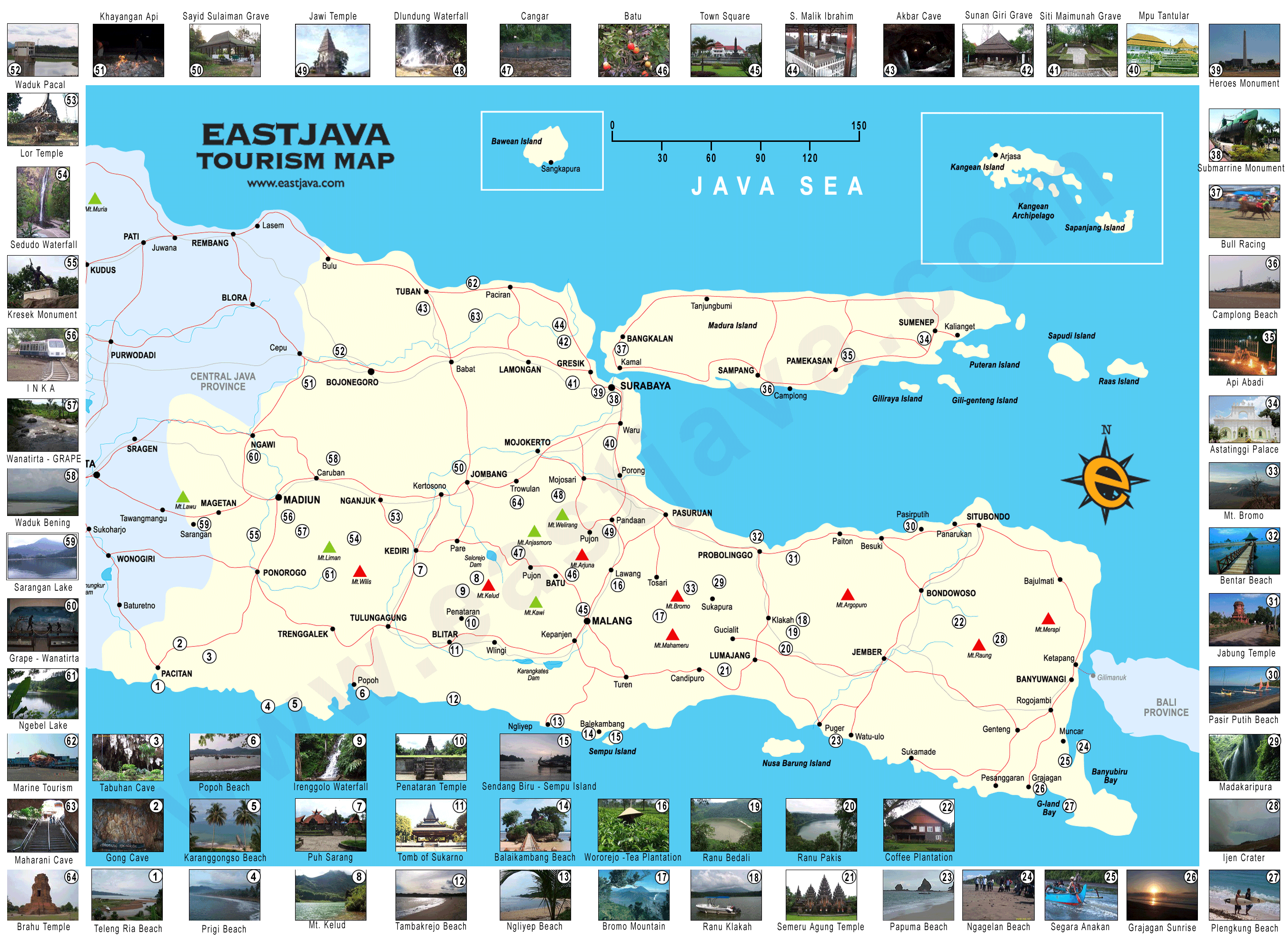
East Java is a province of Indonesia. It is located on the eastern part of the island of Java and includes the neighbouring islands of Madura, and the Kangean, Sapudi, Bawean, and Masalembu groups.
Its capital is Surabaya, the 2nd largest city in Indonesia and a major industrial center and port. It covers an area of 47,922 km2. At the 2010 Census, the province's population was 37,476,000.
It has a land border only with the province of Central Java to the west, being surrounded by sea on all other sides.
East JavaEast Java's history dates back to the famous ancient kingdoms of Kediri and Singosari, which is now a city near Malang. The Majapahit empire, centered at Trowulan, Mojokerto East Java, is celebrated by Indonesians as the golden age of the archipelago. Most of the Eastern Java region was part of the Mataram Kingdom during its peak, apart from the Kingdom of Blambangan at Java's far eastern end nearest to Bali.
East Java is administratively divided into 29 regencies, together with 9 cities (or kotamadya) that are independent of the regency in which they sit.
According to the 2000 census, East Java has 34,765,993 inhabitants, which had increased to 37,476,011 at the 2010 Census, making it the 2nd most populous Indonesian province after West Java. The inhabitants are predominantly ethnically Javanese. Native minorities include migrants from nearby Madura, and distinct Javanese ethnicities such as the Tengger people in Bromo, the Samin and the Osing people in Banyuwangi. East Java also hosts a significant population of other ethnic groups, such as Chinese, Indians, and Arabs. In addition to the national language, Indonesian, they also speak Javanese. Javanese as spoken in the western East Java is a similar dialect to the one spoken in nearby Central Java, with its hierarchy of high, medium, and low registers. In the eastern cities of Surabaya, Malang, and surrounding areas, a more egalitarian version of Javanese is spoken, with less regard for hierarchy and a richer vocabulary for vulgarity.
Hinduism and Buddhism once dominated the island, however Islam, gradually supplanted Hinduism in the 14th and 15th centuries. The last nobles and loyalists of the fallen empire of Majapahit fled from this point to Bali. Islam spread from northern cities in Java where traders from Gujarat, India brought with them Islam. The eastern part of East Java, from Surabaya to Pasuruan, and the cities along the coast, and back to Banyuwangi to Jember, are known as the "horseshoe area" in context with earlier Muslim communities living there.
Pockets of Hinduism
streams of Islam and Hinduism
remain, and syncretic abangan
remain strong.
East Java will build 4
Gresik, Probolinggo and
seaports by 2013 in Lamongan,
Banyuwangi.
Another important form of education that is available in most cities in East Java is the pesantren. This kind of education is built and organized by Islamic clerics, and associated with local or national Muslim organizations. Jombang is a famous city for its pesantren.
East Java supports several regional media outlets. Local newspapers with provincial news reach their readers earlier than their competitors from Jakarta. In the spirit of "providing more news from around readers", most newspapers even issue municipal sections which are different among their distribution areas.
East Java cuisine tends
Central Java.
to be saltier than that of
-

Related Sites for East Java

  • Visit East Java : is The Real Tropical Country of Indonesia Tourism read East Java
  • Visit East Java : is The Real Tropical Country of Indonesia Tourism read East Java
  • Audax East Java read East Java
  • East Java, Indonesia : A Tropical Paradise in The World. Find … read East Java