Minahasa people
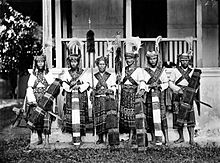
Minahasa Raya is the area covering Bitung City, Manado City, Tomohon City, Minahasa Regency, North Minahasa Regency, South Minahasa Regency and Southeast Minahasa Regency, which are altogether seven of the fifteen regional administrations in the province of North Sulawesi, Indonesia.
 Originally inhabited by Nuclear Malayo-Polynesian languages-speaking peoples, the region was colonized in the 16th century by the Portuguese and Spanish, then in the 17th century by the Dutch.
In the Dutch East Indies the Minahasa people identified strongly with the Dutch language, culture and the Protestant faith â€" so strongly, in fact, that when Indonesia became independent in 1945 certain factions of political elites of the region even pleaded with the Dutch to let it become a province of the Netherlands. The centuries old strong bond between the Minahasa and the Netherlands has recently been studied and explained using the Stranger King concept.
There is a considerable number of people from the Minahasa living in the Netherlands, as part of the Indo community.
The name of the land of Minahasa has been changed several times: Batacina-Malesung-Minaesa and then finally the current name Minahasa, meaning "becoming one united". This name dates from the war against the southern Kingdom of Bolaang Mangondow. However, other sources cite that the original name of Minahasa was Malesung, meaning "paddy rotary", then changed to Se Mahasa, meaning "they that unite," and finally Minahasa, meaning "becoming one united."
North Sulawesi never developed any large empire. In 670, the leaders of the different tribes, who all spoke different languages, met by a stone known as Watu Pinawetengan. There they founded a community of independent states, who would form one unit and stay together and would fight any outside enemies if they were attacked.
Until well into the 19th century the Minahasa was composed of rivaling warrior societies that practiced headhunting. Only during 'Pax Neerlandica' of the formal colonisation of the Dutch East Indies did the state of permanent internal warfare and the practice of headhunting subside.
The Minahasa region of north Sulawesi is thought to have 1st been inhabited by humans in the late 3rd and 2nd millennia BC. The Austronesian people originally inhabited southern China before moving and colonising areas in Taiwan, the northern Philippines, the southern Philippines, and on to Borneo, Sulawesi, and the Moluccas.
According to Minahasa mythology the Minahasans are descendants of Toar and Lumimuut. Initially, the descendants of Toar-Lumimuut were divided into 3 groups: Makatelu-pitu, Makarua-siouw (two times nine) and Pasiowan-Telu (nine times three). They multiplied quickly. But soon there were disputes among these people. Their leaders named Tona'as then decided to meet and talk about this. They met in Awuan (north of the current Tonderukan hill). That meeting was called Pinawetengan u-nuwu (dividing of language) or Pinawetengan um-posan (dividing of ritual). At that meeting the descendants were divided into three groups named Tonsea, Tombulu, and Tontemboan corresponding to the groups mentioned above. At the place where this meeting took place a memorial stone called Watu Pinabetengan (Stone of Dividing) was then built. It is a favourite tourist destination.
The groups Tonsea, Tombulu, and Tontemboan then established their main territories which were Maiesu, Niaranan, and Tumaratas respectively. Soon several villages were established outside these territories. These new villages then became a ruling center of a group of villages called puak, later walak, comparable to the present-day district.
Subsequently a new group of people arrived in Pulisan peninsula. Due to numerous conflicts in this area, they then moved inland and established villages surrounding a large lake. These people were therefore called Tondano, Toudano or Toulour. This lake is now the Tondano lake.
| Eight of these ethnic linguistic groups. | groups are also separate - |
Until the dominance of Dutch influence in the 17th and 18th century the Minahassans lived in warrior societies that practised headhunting.
In the 2nd half of the 16th century, both Portuguese and the Spanish arrived in North Sulawesi. Half-way though the 17th century there was a rapprochement between the Minahasan chiefs and the Dutch VOC, which was given concrete form in the treaty of 1679 (which can be found in the Corpus Diplomaticus Neerlando-Indicum 1934, vol. III, no 425). From 1801-1816, the Netherlands were occupied by the French imperial forces of Napoleon and the Minahasa came under English control. In 1817 Dutch rule was re-established until 1949.
At the time of the 1st contact with Europeans the sultanate of Ternate held some sway over North Sulawesi, and the area was often visited by seafaring Bugis traders from South Sulawesi. The Spanish and the Portuguese, the 1st Europeans to arrive, landed in Minahasa via the port of Makasar, but also landed at Sulu Island and at the port of Manado. The abundance of natural resources in Minahasa made Manado a strategic port for European traders sailing to and from the spice island of Maluku. Although they had sporadic contacts with Minahasa, the Spanish and Portuguese influence was limited by the power of the Ternate sultanate.
The Portuguese and Spaniards left reminders of their presence in the north in subtle ways. Portuguese surnames and various Portuguese words not found elsewhere in Indonesia, like garrida for an enticing woman and buraco for a bad man, can still be found in Minahasa. In the 1560s the Portuguese Franciscan missionaries made some converts in Minahasa.
The Spanish had already set themselves up in the Philippines and Minahasa was used to plant coffee that came from South America because of its rich soil. Manado was further developed by Spain to become the center of commerce for the Chinese traders who traded the coffee in China. With the help of native allies the Spanish took over the Portuguese fortress in Amurang in the 1550s, and Spanish settlers also established a fort at Manado, so that eventually Spain controlled all of the Minahasa. It was in Manado where one of the 1st Indo-Eurasian communities in the archipelago developed during the 16th century. The 1st King of Manado (1630) named Muntu Untu was in fact the son of a Spanish Mestizo.
By the early 17th century the Dutch had toppled the Ternate sultanate, and then set about eclipsing the Spanish and Portuguese. As was the usual case in the 1640s and 50s, the Dutch colluded with local powers to throw out their European competitors. In 1677 the Dutch occupied Pulau Sangir and, two years later, the Dutch governor of Maluku, Robert Padtbrugge, visited Manado. Out of this visit came a treaty with the local Minahasan chiefs, which led to domination by the Dutch for the next 300 years although indirect government only commenced in 1870.
The Dutch helped unite the linguistically diverse Minahasa confederacy, and in 1693 the Minahasa scored a decisive military victory against the Bolaang to the south. The Dutch influence flourished as the Minahasans embraced European culture and Christian religion. Missionary schools in Manado in 1881 were among the 1st attempts at mass education in Indonesia, giving their graduates a considerable edge in gaining civil service, military and other positions of influence.
Relations with the Dutch were often less than cordial and the region didn't actually come under direct Dutch rule until 1870. The Dutch and the Minahasans eventually became so close that the north was often referred to as the 12th province of the Netherlands. A Manado - based political movement called Twaalfde Provincie even campaigned for Minahasa's integration into the Dutch state in 1947.
Portuguese activity apart, Christianity became a force in the early 1820s when a Calvinist group, the Netherlands Missionary Society, turned from an almost exclusive interest in Maluku to the Minahasa area. The wholesale conversion of the Minahasans was almost complete by 1860. With the missionaries came mission schools, which meant that, as in Ambon and Roti, Western education in Minahasa started much earlier than in other parts of Indonesia. The Dutch government eventually took over some of these schools and also set up others. Because the schools taught in Dutch, the Minahasans had an early advantage in the competition for government jobs and places in the colonial army. Minahasans remain among the educated elite today.
A relatively large number of Minahasans pursued professional military careers in the colonial army. Next to the South Moluccan Ambonese, the Minahasa Menadonese were also considered a martial race and therefore particularly competent and trustworthy as soldiers. As KNIL soldiers the Minahasans fought alongside the Dutch to subdue rebellions in other parts of the archipelago, such as for instance the Java War of 1825-30.
Related Sites for Minahasa people
- Minahasa People | Facebook read Minahasa people
- Minahasa People Culture North Sulawesi Indonesia read Minahasa people
- Minahasa people | Facebook read Minahasa people


