Wednesday, 10 November 2021

Pasha (Mean)

Pasha

Pasha, previously known as bashaw, was a prestigious rank within the political and military system of the Ottoman Empire. It was usually bestowed upon governors, generals, dignitaries, and other high-ranking officials. The title of Pasha was considered an honorific, and it came in various ranks, comparable to the British title of Lord. In pre-republican Egypt, Pasha was also one of the most esteemed titles. The Pasha rank had three levels, with the highest being the first class, which allowed the holder to bear a standard with three horse-tails. The second class was allowed two, and the third class was permitted one.
PashaThe English word "pasha" comes from the Turkish word "paşa," which is believed to have Persian and Turkish roots. Some scholars connect it with the Persian word "pādšā" meaning "king," while others connect it with the Turkish words "baş(-ı)" meaning "head," or "baş-ağa," the title of an official. However, etymologist Sevan Nişanyan argues that "pasha" comes from the Turkish word "beşe," meaning "boy" or "prince," which is derived from the Persian word "baxxe." In Old Turkish, there was no distinction between the sounds /b/ and /p/, and the word was spelled "başa" until the 15th century.
Initially, the title "pasha" was used in Western Europe with the initial "b," and English forms such as "bashaw," "bassaw," and "buch" were common in the 16th and 17th centuries, which were derived from the medieval Latin and Italian word "bassa." In Arabic-speaking regions, due to the Ottoman Empire's presence, the title became frequently used in Arabic, although pronounced as "basha" due to the absence of the sound "p" in Arabic. The title "pasha" was initially applied only to military commanders, but later it became a title for any high official or anyone the court desired to honor, including unofficial persons.
The title was spelled with the initial "b" when first used in western Europe, appearing as bashaw, bassaw, or bucha, and was commonly used in the Arab World due to Ottoman presence, pronounced as basha in Arabic. Pashas held a higher rank than Beys and Aghas but ranked below Khedives and Viziers. The number of yak- or horse-tails or peacock tails displayed on their standard, a symbol of military authority during campaigns, distinguished the three grades of Pasha. The Sultan was the only person entitled to four tails. The title could be applied to any high official or unofficial person that the court wanted to honor. If a Pasha governed a provincial territory, it could be called a pashaluk, with the administrative term of the jurisdiction designated by terms such as eyalet, vilayet/walayah. Both Beylerbeys and valis/wālis were entitled to the style of Pasha, typically with two tails. Ottoman and Egyptian authorities conferred the title on both Muslims and Christians and frequently gave it to foreigners in their service. The title was an aristocratic honorific and could be hereditary or non-hereditary, stipulated in the Firman issued by the Sultan carrying the imperial seal "Tughra". The title did not bestow rank or title on the wife or elevate any religious leader to the title. Unlike western nobility titles, Ottoman titles followed the given name, and holders of the title Pasha were often referred to as "Your Excellency" in contacts with foreign emissaries and representatives.

In current Egyptian and Levantine Arabic, the title "Pasha" is more similar to "Sir" than "Lord" and is commonly used by older individuals. Among younger generations in Egypt, it is considered an informal way of addressing male peers since the abolition of aristocratic titles after the Revolution of 1952. While it is not an official title, the public and media in Turkey use "Pasha" to refer to general officers in the Turkish Armed Forces.


Thursday, 6 November 2014

X Factor Indonesia

X Factor Indonesia

X Factor Indonesia

The X Factor Indonesia is a reality TV music competition that aims to discover new singing talents in Indonesia. The winner of the competition is awarded 1 billion rupiah and a recording contract with Sony Music Indonesia. The show premiered on December 28, 2012 on RCTI and is the second franchise in Southeast Asia after the Philippines.

Unlike its rival, Indonesian Idol, The X Factor Indonesia is based on the British The X Factor franchise and has several unique features. The competition is open to both individuals and groups, and there is no upper age limit. The judges are assigned one of four categories, which are boys aged 15 to 25, girls aged 15 to 25, individuals aged 26 and over, and groups. During the live shows, the judges mentor their assigned category, helping them with song choices, styling, and staging, while also judging contestants from other categories. The judges also compete to ensure that their act wins the competition, making them the winning judge.

The original judging panel of The X Factor Indonesia consisted of Ahmad Dhani, Rossa, Anggun, and Bebi Romeo, with Robby Purba as the host. Fatin Shidqia is the only winner of the show so far.

Although Indonesian Idol became a massive success and the number one show in Indonesia for seven consecutive seasons, the original UK version, Pop Idol, did not perform well. Simon Cowell, a judge on Pop Idol, wanted to launch a show that he owned the rights to. While the first series of Pop Idol was hugely successful, the second series experienced a drop in viewer figures, and some, including Pop Idol judge Pete Waterman, considered Michelle McManus to be an undeserving winner. Pop Idol was axed in 2004, and Simon Cowell announced a new show, The X Factor, created without the involvement of Idol creator Simon Fuller. The X Factor's ratings were initially average, but by the sixth series in 2009, ratings had reached 10 million viewers per week.

In March 2010, RCTI, the broadcaster of Indonesian Idol, signed a deal to launch the Indonesian version of The X Factor. Initially, X Factor Indonesia was intended to replace Indonesian Idol in 2013, but due to the immense success of the seventh season of Indonesian Idol in 2012, RCTI and FremantleMedia decided to continue collaborating with both shows airing on alternate years. To replicate the success of the seventh season of Indonesian Idol, Fabian Dharmawan from RCTI was appointed as the executive producer for RCTI for the first season of The X Factor Indonesia, while Glenn Sims, the head of entertainment for FremantleMedia, Virgita Ruchiman, and Ken Irawati served as executive producers for FremantleMedia Indonesia.

The X Factor Indonesia started airing short commercials in August 2012, with a second promo featuring various Indonesian artists and One Direction. The show premiered on December 28, 2012, and focuses on identifying singing talent, with appearance, personality, stage presence, and dance routines also playing a role. The competition is open to solo artists and vocal groups aged 15 and above, with no upper age limit. Auditions are held in front of the producers first, and then those who pass are invited to perform for the judges in front of a live audience. The judges' auditions require at least three out of four judges to say "yes" for the auditionee to move forward. There is also an online audition process, where the auditionees can upload their performance on the X Factor Indonesia website and receive votes from viewers on YouTube. The judges act as mentors to their category and help contestants with song choices, styling, and staging while judging contestants from other categories. A selection of the auditions is broadcast over the first few weeks of the show, featuring the best, worst, and most bizarre auditions.

The contestants selected at auditions are further refined through a series of performances at "bootcamp", and then at the "judges' home visits", until a small number eventually progress to the live finals. In the bootcamp, contestants will have to go through a series of challenges until the number of contestants were trimmed down to 26 and divided according to their categories. At the end of bootcamp, the producers will also reveal which category the judges will be mentoring. The judges then disband for the "judges' home visits" round, where they further reduce their acts on location at a residence with the help of a celebrity guest mentor.

The finals consist of a series of two gala live shows, with the first featuring the contestants' performances and the second revealing the results of the public voting. Celebrity guest performers will be featured regularly. The performance show occasionally begins with a group performance from the remaining contestants. The show is primarily concerned with identifying a potential pop star or star group, and singing talent, appearance, personality, stage presence, and dance routines are all important elements of the contestants' performances. In the initial live shows, each act performs once in the first show in front of a studio audience and the judges, usually singing over a pre-recorded backing track. Dancers are also commonly featured. Acts occasionally accompany themselves on guitar or piano. Each live show has a different theme, and each contestant's song is chosen according to the theme. After each act has performed, the judges comment on their performance. Heated disagreements, usually involving judges defending their contestants against criticism, are a regular feature of the show. Once all the acts have appeared, the phone lines open, and the viewing public vote on which act they want to keep. Once the number of contestants has been reduced to six, each act performs twice in the performances show. This continues until only three acts remain. These acts go on to appear in the grand final, which decides the overall winner by public vote.

The two acts polling the fewest votes are revealed. Both these acts have to perform again in a "final showdown," and the judges vote on which of the two to send home. They were able to pick new songs to perform in the "final showdown". Ties are possible as there are four judges voting on which of the two to send home. In the event of a tie, the result goes to deadlock, and the act who came last in the public vote is sent home. The actual number of votes cast for each act isn't revealed, nor even the order. Once the number of contestants has been reduced to five, the act that polled the fewest votes is automatically eliminated from the competition.

The winner of the X Factor Indonesia is awarded a recording contract from Sony Music Indonesia, which would include investments worth 1 billion rupiah, which is claimed as the largest guaranteed prize in Indonesian television history. Several cash rewards from the sponsors, including a new car, is also awarded for the grand finalists in the 1st season.

There were several rumored candidates for the judging panel, such as Indra Lesmana, Titi DJ, Maia Estianty, Vina Panduwinata, Tompi, Anang Hermansyah, Sherina Munaf, Agnes Monica, Ruth Sahanaya, and Iwan Fals. Eventually, Ahmad Dhani, Bebi Romeo, Rossa, and Anggun were confirmed as judges for the show, with Mulan Jameela stepping in for Anggun during auditions due to her ongoing concert tour in Europe. The show had various potential hosts, including VJ Boy William and Daniel Mananta, but Robby Purba was ultimately announced as the host on November 23, 2012.

Each judge is assigned a category to mentor and selects a small group of contestants to advance to the live shows. During season one, Ahmad Dhani and Rossa's decision to eliminate Alex Rudiart instead of Gede Bagus caused public backlash and calls to boycott the show.

On September 29, 2012, Cross Mobile was named the official sponsor of X Factor Indonesia, with an extensive multi-platform marketing partnership both on and off-air. Kopi ABC was announced as the second official sponsor on December 26, while Indosat Mentari was named the third official sponsor on December 28. Oriflame served as the official make-up sponsor, and Procter & Gamble promoted its Pantene, Olay, and Downy brands through the show.


Monday, 1 September 2014

A brief introduction to Dart


A brief introduction to Dart : Dart is a modern programming language developed by Google for web development. It provides developers with a new set of tools and features that make it easier to write modular, structured, and object-oriented applications. With Dart, developers can create both client and server-side applications that are more efficient and scalable.

One of the key benefits of using Dart is its class-based object-oriented programming model, which allows developers to create reusable and extensible code. Dart's syntax is also similar to that of other popular programming languages, such as Java or C#, making it easy for developers to learn and use.

When it comes to client-side development, Dart has its own high-featured library for Document Object Model (DOM) manipulation and event handling. This makes it easier for developers to build complex and responsive web applications. The language also provides optional typing, which can help catch errors at compile-time rather than runtime.

Furthermore, Dart also allows developers to write server-side code. This means that developers can create a homogeneous system that covers both client and server. This is particularly useful for creating web applications that require a lot of server-side processing.

Despite its potential, Dart is still a relatively new language and is not yet widely adopted. As a result, it may not be suitable for use in production environments. However, developers who are interested in broadening their horizons may find it worthwhile to explore the language and try building sample applications.

One of the challenges facing Dart is whether it will be widely supported by popular browsers. While the language provides many benefits, it requires native support from browsers to be widely adopted. Developers will have to wait and see whether major browser developers will implement support for Dart or not. Nonetheless, Dart has the potential to make a significant impact on web development and is definitely worth keeping an eye on.

Sunday, 31 August 2014

Semi-supervised learning : Major varieties of learning problem

Semi-supervised learning : Major varieties of learning problem
Machine learning focuses on five main types of learning problems, with the first four falling under the category of function estimation. These problems can be grouped based on two dimensions: whether the learning task is supervised or unsupervised and whether the variable to be predicted is nominal or real-valued.

The first type of problem is classification, which involves supervised learning of a function f(x) that predicts a nominal value. The function learned is called a classifier, and it determines the class to which an instance x belongs based on its input. For example, the task might involve classifying a word in a sentence based on its part of speech. The learner is given labeled data, which includes instances along with their correct class labels. Using this data, the classifier learns to make predictions for new instances.

The concept of clustering is the unsupervised equivalent to classification. In clustering, the goal is also to assign instances to classes, but the algorithm only has access to the instances themselves, not the correct answers for any of them. The primary difference between classification and clustering is the type of data that is provided to the learner as input, specifically whether it is labeled or not. Two other important function estimation tasks include regression, where the learner estimates a function that takes on real values instead of finite values, and unsupervised learning of a real-valued function, which can be seen as density estimation. In this case, the learner is given an unlabeled set of training data and is tasked with learning a function that assigns a real value to every point in the space. Finally, reinforcement learning is another type of learning where the learner receives a stream of data from sensors and is expected to take actions based on this data. There is also a reward signal that the learner tries to maximize over time. The key differences between reinforcement learning and the other four function estimation settings are the sequential nature of the inputs and the indirect nature of the supervision provided by the reward signal.
 
Semisupervised learning is a form of machine learning that combines elements of both supervised and unsupervised learning. The distinction between these two approaches lies in whether or not the training data is labeled, with supervised learning relying on labeled data to classify and predict outcomes, while unsupervised learning seeks to discover patterns and structure within unlabeled data. In contrast, semisupervised learning involves providing some labeled data to the learner, while leaving the rest unlabeled. This mixed setting is the canonical case for semisupervised learning, and many methods have been developed to take advantage of it.

However, labeled and unlabeled data are not the only ways of providing partial information to the learner about the labels for training data. For instance, a few reliable rules for labeling instances or constraints limiting the candidate labels for specific instances could also be used. These alternative methods of partial labeling are also relevant to semisupervised learning and are often used in practice. While reinforcement learning could also be seen as a form of semisupervised learning because it relies on indirect information about labels, the connection between reinforcement learning and other semisupervised approaches is not well understood and is beyond the scope of this discussion.

Introduction of Semi-supervised Learning for Computational Linguistic

Introduction of Semi-supervised Learning for Computational Linguistic


Creating sufficient labeled data can be very time-consuming. Obtaining the output sequences is not difficult: English texts are available in great quantity. What is time-consum
Introduction of Semi-supervised Learning for Computational Linguistic
Advancements in computational linguistics have resulted in the creation of different algorithms for semisupervised learning, including the Yarowsky algorithm which has gained prominence. These algorithms have been developed specifically to tackle the common problems that arise in computational linguistics. Such problems involve scenarios where there is a correct linguistic answer, a large amount of unlabeled data, and very limited labeled data. In contrast to acoustic modeling, classic unsupervised learning is not suitable for these problems because any way of assigning classes is not acceptable. Although the learning method is mostly unsupervised since most of the data is unlabeled, labeled data is essential because it provides the only characterization of the linguistically correct classes.

The algorithms just mentioned turn out to be very similar to an older learning method known as self-training that was unknown in computational linguistics at the time. For this reason, it is more accurate to say that they were rediscovered, rather than invented, by computational linguists. Until very recently, most prior work on semisupervised learning has been little known even among researchers in the area of machine learning. One goal of the present volume is to make the prior and also the more recent work on semisupervised learning more accessible to computational linguists.

Shortly after the rediscovery of self-training in computational linguistics, a method called co-training was invented by Blum and Mitchell, machinelearning researchers working on text classification. Self-training and co-training have become popular and widely employed in computational linguistics; together they account for all but a fraction of the work on semisupervised learning in the field. We will discuss them in the next chapter. In the remainder of this chapter, we give a broader perspective on semisupervised learning, and lay out the plan of the rest of the book.

Motivation of Semi-supervised Learning


For most learning tasks of interest, it is easy to obtain samples of unlabeled data. For many language learning tasks, for example, the World Wide Web can be seen as a large collection of unlabeled data. By contrast, in most cases, the only practical way to obtain labeled data is to have subject-matter experts manually annotate the data, an expensive and time-consuming process.

The great advantage of unsupervised learning, such as clustering, is that it requires no labeled training data. The disadvantage has already been mentioned: under the best of circumstances, one might hope that the learner would recover the correct clusters, but hardly that it could correctly label the clusters. In many cases, even the correct clusters are too much to hope for. To say it another way, unsupervised learning methods rarely perform well if evaluated by the same yardstick used for supervised learners. If we expect a clustering algorithm to predict the labels in a labeled test set, without the advantage of labeled training data, we are sure to be disappointed.

The advantage of supervised learning algorithms is that they do well at the harder task: predicting the true labels for test data. The disadvantage is that they only do well if they are given enough labeled training data, but producing sufficient quantities of labeled data can be very expensive in manual effort. The aim of semisupervised learning is to have our cake and eat it, too. Semisupervised learners take as input unlabeled data and a limited source of label information, and, if successful, achieve performance comparable to that of supervised learners at significantly reduced cost in manual production of training data.

We intentionally used the vague phrase “a limited source of label information.” One source of label information is obviously labeled data, but there are alternatives. We will consider at least the following sources of label information:
  • labeled data
  • a seed classifier
  • limiting the possible labels for instances without determining a unique label
  • constraining pairs of instances to have the same, but unknown, label (co-training)
  • intrinsic label definitions
  • a budget for labeling instances selected by the learner (active learning)

The goal of unsupervised learning in computational linguistics is to enable autonomous systems to learn natural language without the need for explicit instruction or manual guidance. However, the ultimate objective is not merely to uncover interesting language structure but to acquire the correct target language. This may seem daunting since learning a target language without labeled data appears implausible. 
 
Nevertheless, semisupervised learning, which combines unsupervised and supervised learning methods, may offer a starting point. By using unsupervised learning to acquire a small amount of labeled data, semisupervised learning can potentially extend this to a complete solution. This process seems to resemble human language acquisition, where bootstrapping refers to the initial acquisition of language through explicit instruction, and distributional regularities of linguistic forms play a crucial role in extending this to the entirety of the language. Semisupervised learning methods thus provide a possible explanation for how the initial kernel of language is extended in human language acquisition.

Supervised and unsupervised training with Hidden Markov Models

Hidden Markov Models in Supervised and unsupervised training


Supervised and unsupervised training with Hidden Markov Models
Church and DeRose utilized Hidden Markov Models (HMMs) in their computational linguistics work, which were originally developed for speech recognition. HMMs are probabilistic models that generate sequences of states and parallel sequences of output symbols. In language modeling, the output symbols represent sentences in natural language. The automaton defined by an HMM can be in several distinct states, and it starts by randomly selecting a state. The automaton then emits a symbol, chooses a new state, and repeats the process. Each choice is stochastic and made randomly based on a distribution over output symbols or next states, depending on the type of choice and the current state.

The model consists of numeric values representing the probability of choosing a specific transition or emission. Learning an HMM is simple if labeled data is provided, which pairs state sequences with output sequences. To estimate the probability of choosing a particular value when making a stochastic choice of a specific type, one can count how often that choice was made in the labeled data.

Church and DeRose used HMMs to tackle part-of-speech tagging by associating the states of the automaton with parts of speech. The automaton generates a sequence of parts of speech and emits a word for each part of speech, resulting in a tagged text where each word is annotated with its corresponding part of speech. Supervised learning of an HMM for part-of-speech tagging is effective, with HMM taggers for English having an error rate of around 3.5 to 4 percent. The success of these models in part-of-speech tagging was what initially drew attention to probabilistic models in computational linguistics.

Probabilistic methods in computational linguistics

Computational linguistics : Probabilistic methods

Probabilistic methods in linguistics
Computational linguistics is a field that aims to develop techniques for processing human languages through automatic means. Since the introduction of electronic computers in the late 1940s, researchers have been interested in machine translation, which was one of the earliest topics to attract attention. The development of computers was inspired by the idea of creating a thinking machine, or machina sapiens, and language was considered a uniquely human cognitive ability. Early work on artificial intelligence pitted symbolic reasoning against stochastic systems like neural nets. However, it soon became apparent that a solid probabilistic foundation was necessary to deal with uncertainty.

In computational linguistics, the belief in the adequacy of grammatical and logical constraints, supplemented by ad hoc heuristics, persisted for a long time. However, when the field acknowledged the importance of probabilistic methods, the shift was rapid and significant. The emergence of statistical part-of-speech tagging in 1988, which was described in papers by Church and DeRose, can be seen as the beginning of this awareness.

Prior to the papers by Church and DeRose, stochastic methods for part of speech disambiguation had been proposed, but they had not gained much prominence in computational linguistics. However, the papers by Church and DeRose had a profound impact on the field and reshaped it within a decade. At the time, one of the major challenges in natural language processing was the fragility of manually constructed systems. Ambiguity resolution, portability, and robustness were the primary issues. Semantic constraints were often too loose, leading to numerous viable analyses, or too strict, ruling out the correct analysis. Hence, there was a need for automatic methods that could soften constraints and resolve ambiguities. Portability required the adaptation of systems to variability across application domains, and robustness demanded the handling of errorful input and incomplete grammars. These challenges necessitated the use of automatic learning methods, which explains why probabilistic methods and machine learning, in particular, gained rapid penetration. Nowadays, computational linguistics is inseparable from machine learning.

Wednesday, 6 August 2014

Harmoni Cinta : an album by Gita Gutawa

Harmoni Cinta

Harmoni Cinta is an album that was released by Gita Gutawa in 2009 under Sony Music Indonesia. The album's purpose was to contribute a portion of the sales to help underprivileged students receive an education. It was created through a collaboration between Gutawa and several Indonesian musicians, such as her father Erwin, as well as renowned artists such as Melly Goeslaw and Glenn Fredly. The production process took around nine months, starting in June 2008 and ending in March 2009. Dick Lee, a songwriter from Singapore, also contributed to the album by composing the song "Remember." Harmoni Cinta includes a cover of the title song from Chrisye's Aku Cinta Dia album.
Harmoni Cinta

The recording of Harmoni Cinta involved several locations around the world. The vocals were recorded in Jakarta, while the orchestral pieces were recorded separately by the City of Prague Philharmonic Orchestra and the Sofia Symphonic Orchestra in their respective cities. The album was mixed in two different studios, with six songs mixed at 301 Studio in Sydney and the remaining six mixed at Aluna Studio in Jakarta. "Aku Cinta Dia" was later mastered in New York at Sterling Sound Mastering. This collaborative effort resulted in work on the album taking place across four different continents.

Gita Gutawa played a bigger role in the creation of Harmoni Cinta compared to her first self-titled album. She was involved in determining the album's overall concept, selecting the songs to include, and even wrote five of them. The album itself is a combination of light and enjoyable teen pop with orchestrated classic pop. Like her previous album, Gita Gutawa explored themes such as young love, friendship, family ties, and worldliness.

One of the album's tracks, "Parasit," is a story of puppy love between two pre-teens, with references to biology, physics, and geography, including the Sahara Desert, Antarctica, and outer space. Another track, "Harmoni Cinta," features extravagant orchestral backing, while "Mau Tapi Malu" has a more coquettish tone with Gita singing alongside Mey Chan and Maia Estianty. "Remember" is a bilingual track with both English and Indonesian lyrics, and traditional instruments are used in its arrangement. The remaining tracks, "Selamat Datang Cinta," "Meraih Mimpi," "Lullaby," and "When You Wish Upon a Star," are slower and more minimalistic in style.

1996 Thomas Cup

1996 Thomas Cup

1996 Thomas Cup

The 1996 Thomas & Uber Cup was a major international badminton tournament held in Indonesia. It was the 19th tournament of the Thomas Cup and the 16th tournament of the Uber Cup. The tournament was held to determine the best teams in the world of badminton, and it attracted top players from all over the globe.

The press conference for the 1996 Thomas Cup was held in the Bank Rakyat Indonesia's building in Sentra BRI complex in Sudirman, Central Jakarta. The press conference was led by Putera Sampoerna, the chairman of PT HM Sampoerna Tbk, which is the manufacturer of A Mild, the fifth largest cigarette brand in Indonesia. A Mild was also the main sponsor of the 1996 TUC, and as such, Putera Sampoerna played a significant role in the organization of the tournament.

The opening and closing ceremony of the 1996 TUC were also led by Putera Sampoerna, as A Mild was the main sponsor of the tournament. The ceremonies were grand affairs, with dazzling displays of fireworks and cultural performances.

The Indonesian Thomas & Uber Cup Squads were the reigning champions in both the Thomas Cup and the Uber Cup, having won the titles for the third time. The squads were united in their quest for victory, and they were determined to defend their titles against tough competition from the world's best badminton players.

Overall, the 1996 Thomas & Uber Cup was a highly anticipated event in the world of badminton, and it showcased some of the best players in the sport. The tournament was a great success, thanks in large part to the efforts of Putera Sampoerna and the other organizers who worked tirelessly to make it a memorable event for all involved.

Indonesia's Thomas Cup team consisted of some of the best players in the world at the time, including Joko Suprianto, Hermawan Susanto, and Rexy Mainaky. The team was led by the legendary coach, Liem Swie King, who had previously led Indonesia to Thomas Cup victories in 1978 and 1980.

In the final of the Thomas Cup, Indonesia faced the formidable Korean team, who had won the Cup in 1992. The final was held in Hong Kong, and was a tense and closely contested affair. Indonesia took an early lead, winning the first two singles matches, but Korea fought back to level the scores at 2-2. The deciding match was the second doubles, which pitted the Indonesian pairing of Ricky Subagja and Rexy Mainaky against Korea's Ha Tae-kwon and Kang Kyung-jin. In a thrilling match that lasted over an hour, Subagja and Mainaky prevailed, winning 15-8, 12-15, 15-12, to secure Indonesia's third Thomas Cup title.

The Indonesian Uber Cup team was also strong, featuring players such as Susi Susanti, Mia Audina, and Finarsih. They faced the tough Chinese team in the final, who were the defending champions. The final was held in Hong Kong, and was another closely fought contest. China took an early lead, winning the first singles match, but Indonesia fought back to level the scores at 1-1. The deciding match was the second singles, which pitted Susi Susanti against China's Tang Yongshu. In a tense match, Susanti prevailed, winning 11-8, 11-9, to secure Indonesia's third Uber Cup title.

The victories of both the Thomas Cup and Uber Cup teams were celebrated widely in Indonesia, and the players and coach Liem Swie King were hailed as national heroes. The 1996 TUC was a major milestone for Indonesian badminton, and helped to cement the country's reputation as a dominant force in world badminton.


Thursday, 24 July 2014

Once : popular Indonesian singer

Once

Once, also known as Elfonda Mekel, is a popular Indonesian singer who used to be the lead vocalist of Dewa 19. He was born on May 21, 1970, in Ujung Pandang, South Sulawesi. During his time at Tirta Marta Junior High School, Once started singing and also learned how to play the guitar, drums, and piano. He participated in several singing competitions, including one held among high schools in Jakarta. Once joined various bands after graduating from Tirta Mirta Senior High School, starting with cover bands like Brawijaya and Dimensi. He began singing his own songs when he joined Java Burns, and he contributed one of his songs to the compilation album Seribu Angan in the early 1990s.

Once

Once had to take a break from singing between 1993 and 1997 due to a problem with his voice box. During this time, he attended the University of Indonesia to study law and graduated in 1996. In addition to his studies, he worked for a construction company. In 1997, he resumed his singing career by performing in cafes. He then collaborated with Ahmad Dhani to produce the soundtrack for the film Kuldesak in 1998. Once was later invited to join Dhani's band, Dewa 19, in 2000. He replaced Ari Lasso, who was expelled from the group for using drugs. At the beginning of his time with the band, Once struggled to meet the high expectations of Lasso's fans, and he was criticized for being distant from them and having an awkward stage presence. However, Once eventually gained the acceptance of Dewa 19's fans after the success of Pandawa Lima, his first album with the band, which sold 1.7 million copies. He went on to record four more albums with Dewa 19 and also released three solo singles, "Dealova", "Aku Mau", and "Symphony yang Indah" (meaning "A Beautiful Symphony").


Once announced his resignation from Dewa 19 on 19 January 2011, citing his desire to pursue a solo career as the main reason, although rumors have circulated that issues with royalties may have also played a role in his decision. After leaving Dewa 19, Once joined forces with other musicians, including Lasso, Doadibadai Hollo of Kerispatih, Maggi of /rif, Irfan of Samsons, and Yuke, to establish the AYLI Project. At the time of June 2011, he was in the process of recording his debut solo album. Once's musical talent has been recognized in the past, having been awarded the Best Pop Soloist award at the 2005 Anugerah Musik Indonesia and the Best Pop Song award at AMI the following year for one of his compositions.


Elfonda Mekel

Elfonda Mekel


Elfonda Mekel, who is popularly known by his stage name Once ([ˈÉ"ntʃə], pronounced Ohn-chx), is an Indonesian former lead vocalist of Dewa 19 and a singer. Once was born in Ujung Pandang, South Sulawesi, on May 21, 1970. During his time at Tirta Marta secondary school, he started singing and learned to play the drums, piano, and guitar. He participated in various singing competitions, including an inter-high school competition in Jakarta. After completing his studies at Tirta Mirta high school, Once joined different bands, including Brawijaya and Dimensi, where he performed cover songs. Once began singing songs he had written himself after joining Java Burns, and he provided a song for the compilation album Seribu Angan in the early 1990s.

Unfortunately, Once had to take a break from singing between 1993 and 1997 due to a vocal cord issue. During this period, he studied law at the University of Indonesia and graduated in 1996. Additionally, he worked for a construction company.

In 1997, Once began singing again in cafes, and in 1998 he recorded the soundtrack for the movie Kuldesak with Ahmad Dhani. Then, in 2000, Dhani invited Once to join his band, Dewa 19, as a replacement for Ari Lasso, who had been expelled from the group due to drug use. At the start, Once had difficulty meeting the high expectations of Lasso's fans, and he was criticized for his stiff on-stage persona.

However, Once eventually won over Dewa 19's fans with his first album with the group, Pandawa Lima, which was a huge success and sold 1.7 million copies. He went on to record four more albums with Dewa 19, as well as three solo singles, including "Dealova", "Aku Mau", and "Symphony yang Indah" ("A Beautiful Symphony").

On January 19, 2011, Once resigned from Dewa 19 to focus on his solo career, citing issues with royalties as a factor in his decision. He later joined forces with Ari Lasso, Doadibadai Hollo of Kerispatih, Maggi of /rif, Irfan of Samsons, and Yuke to form the AYLI Project. As of June 2011, he was working on his first solo album.

Once was awarded the Best Pop Soloist Award at the 2005 Anugerah Musik Indonesia. The following year, one of his songs was named Best Pop Song at AMI.


Kotak : a modern rock band from Jakarta, Indonesia

Kotak

Kotak

Kotak is a contemporary music group that originates from Jakarta, Indonesia. The group was formed on September 27, 2004, after its members, Julia Angelia Lepar (known as Pare), Prinzes Amanda (known as Icez), Mario Marcella (known as Cella), and Haposan Haryanto Tobing (known as Posan), won the talent competition "The Dream Band" 2004 on TV7. They met Dody Isnaini, a member of the band Kahitna, at an audition who later became their producer. The band began working on their first album, also titled Kotak, which was released in 2005 under the Warner Music Indonesia label. The album featured ten songs including "Hilang", "Terbang", "Damai Hati", and "Kau Pilih Dia".

Three years later, the group released their second album, Kotak Kedua, which received critical acclaim in Indonesia and abroad. The album contained twelve songs, including popular hits such as "Beraksi", "Masih Cinta", and "Tinggalkan Saja". The group continued to release albums with Energi in 2010, Energi Repackage in 2011, Terbaik in 2012, and KFC Adu Bintang in 2013.

In 2007, Pare and Icez left the band, and they were replaced by Tantri Syalindri (known as Tantri) and Swasti Sabdastantri (known as Chua), respectively. Posan, the band's percussionist, also left the group, leading to more changes in membership. Despite these changes, the band remained successful and released their second successful album, Kotak Kedua, in 2008. One of the album's tracks was converted into a ringback tone that has been downloaded over one million times.

In 2011, Kotak collaborated with Simple Plan to record a new version of their song, "Jet Lag". The band has also performed in various countries.

According to an article in the Jakarta Post on November 13, 2012, Kotak, one of Indonesia's most popular rock bands, released a new album titled "Best." The album includes nine of the band's most popular tracks from their previous albums, three new songs, and a bonus track. The album also features the song "Jet Lag," which was created in collaboration with the American punk band Simple Plan. The album sold 200,000 copies.

Tantri, the band's vocalist, won the Best Rock Band/Group and Best Rock Album awards at the AMI in 2009. The band was nominated for the "Best Newcomer Group" award at the Anugerah Planet Music in 2009 and for "Favorite Breakthrough Artist 2009" at the MTV Indonesia Awards.

At the end of 2009, Kotak released their new single "Pelan-Pelan Saja," which was included in their third album "Energi," released in November 2010. The band was invited to perform at an event called Muzik FM organized by Expert & Legends and Raistar Entertainment in Singapore.


Batak peoples

Batak peoples

The Batak people refer to a group of ethnic communities that are primarily located in North Sumatra, Indonesia. This term is used to refer to the Batak subgroups such as the Kluet, Singkil, Karo, Pakpak, Simalungun, Toba, Angkola, and Mandailing. Although these groups have distinct languages and customs, they are considered as connected groups under the Batak term.

Batak peoplesThe Toba people in North Sumatra often identify themselves as "Batak," while other groups who are also considered "Batak" may reject this label and identify specifically as "Simalungun," "Karo," and so on. It is believed that the Batak people evolved from Austronesian speakers who first arrived in Sumatra from Taiwan and the Philippines via Java around 2,500 years ago. While evidence suggests that neolithic settlers lived in southern Sumatra, it seems that the northern part of the island was settled by agriculturalists at a later time.

Despite their reputation for being an isolated people, largely due to their inland location and distance from European colonial influences, there is evidence that the Batak have engaged in trade and contact with neighboring kingdoms for over a thousand years. Historical records of the Batak before 1800 are scarce, but the Biu-Mandara people were likely mentioned in Zhao Rugua's Description of the Barbarous Peoples from the 13th century, which refers to a "Ba-ta" dependency of Srivijaya. The Suma Oriental from the 15th century also mentions the Kingdom of Biu-Mandara, bordered by Pasai and the Aru kingdom.

The Batak people likely participated in trade with Srivijaya for benzoin and resin, which were important commodities for trade with China, and were cultivated in the Batak territories of northwest Sumatra since the eighth or ninth centuries, continuing for the following thousand years. Batak men carried the goods on their backs to be sold at ports, and Barus in Tapanuli was an important port primarily inhabited by Batak people. The city of Kota Cina, established in the eleventh century, became a center of trade with Chinese and Tamil traders, and Tamil remains have been found on trade routes to the Batak lands.

This trade may have prompted Batak migration to the Karo and Simalungun lands, where they were exposed to greater influence from visiting Tamil traders. Additionally, the demand for resin from Srivijaya in the eighth century may have led to Batak migration to the Angkola-Mandailing lands. The Karo tribe of Sembiring, meaning "black one," is believed to have originated from their ties with Tamil traders. Some of the sub-tribes within Sembiring, such as Veda, Colia, Pandia, Depari, Meliala, Muham, Pelawi, and Tekan, have Indian origins. Tamil influence on Karo religious practices, such as the pekualuh secondary incineration ritual, is also apparent.

Starting from the 16th century, Aceh began producing more pepper, which was a valuable export commodity, and therefore needed to import rice, which grew well in the Batak wetlands. Batak people in various regions grew either sawah, wet rice fields, or ladang, dry rice fields, and the Toba Batak, who were most skilled in agriculture, likely migrated to meet the demand in new areas. The increasing importance of rice had religious significance, increasing the power of the Batak high priests, who were responsible for ensuring agricultural success.

The Batak people speak several closely related languages, all of which belong to the Austronesian language family. There are two major branches, a northern branch comprising Pakpak-Dairi, Alas-Kluet, and Karo languages, which are similar to each other, and a distinctly different southern branch, comprising three mutually intelligible dialects: Toba, Angkola, and Mandailing. Simalungun is an early offshoot of the southern branch. Some Simalungun dialects can be understood by Karo speakers, while other Simalungun dialects can be understood by Toba speakers. This is due to the existence of a linguistic continuum that often blurs the distinctions between Batak dialects. Batak language still has an influence on dialects spoken in Medan city to this day.

The Batak have their own writing system called the Surat Batak. The script has mostly ceremonial significance within traditional religious ceremonies and has undergone little change for this reason. It is likely that the Batak people originally received their writing system from southern Sumatra.

The Batak people in Indonesia are organized into patriarchal clans called Marga, with a traditional belief that they all descend from one ancestor called "Si Raja Batak". The Batak are historically known for their skills in weaving, wood carving, and creating ornate stone tombs. They were also once known for their fierce warrior culture before becoming subjects of the colonial Dutch East Indies government. Today, the majority of Batak people are Christians, with a significant presence in education and professions such as teaching, engineering, medicine, and law. However, a minority of Batak people still practice traditional beliefs, also known as perbegu or pemena. The Venetian explorer Niccolx de' Conti described the Batak people as cannibals who wage war on their neighbors, and Sir Thomas Stamford Raffles studied their rituals and laws regarding the consumption of human flesh in the 19th century.

Junghuhn tells however when a dangerous and hungry flight he arrived in an exceedingly friendly village, and therefore the food that was offered by his hosts was the flesh of 2 prisoners United Nations agency had been slaughtered the day before, but he maintains that the Batak exaggerated their love of human flesh so as to intimidate would-be invaders and to achieve occasional employment as mercenaries for the coastal tribes United Nations agency were littered with pirates.

Oscar von Kessel visited Silindung within the decennium and in 1844 was in all probability the first European to watch a Batak savage ritual during which a guilty debauchee was ingested alive. apparently, his description parallels that of Marsden in some necessary respects, but von Kessel states that pattern was regarded by the Batak as a judicial act and its application was restricted to terribly narrowly outlined infringements of the law together with stealing, adultery, spying or treason. Salt, red pepper and lemons had to be provided by the relatives of the victim as a signal that they accepted the decision of the community and weren't thinking of revenge.

Dutch and German missionaries to the Batak within the late nineteenth century ascertained a couple of instances of pattern and wrote lurid descriptions to their home parishes so as to lift donations. The growing Dutch influence in northern island light-emitting diode to redoubled Malay influence in coastal trade and plantations, pushing the Karo farther midland. Growing ethnics tensions culminated within the 1872 Karo Rebellion wherever the Karo were suppressed by Dutch and Malay forces. Despite this, Karo resistance to Dutch imperialism lingered into the first twentieth century. In 1890 the Dutch colonial government prohibited pattern within the regions beneath their management. Rumors of Batak pattern survived into the first twentieth century however it appears probable that the custom was rare when 1816, due part to the influence of Islam.

The Batak lands contains North island province, excluding Nias island and therefore the traditionally Malay kingdoms of the geographic region. additionally, a part of the Karo lands extend into contemporary East Aceh Regency in Aceh province, whereas elements of the Mandailing lands be Rokan Hulu Regency in Riau. important numbers of Batak have migrated in recent years to prosperous neighboring Riau province.

To the south of North island square measure the Muslim Minangkabau of West island, whereas to the north there square measure varied Muslim Acehnese peoples.

The various Batak cultures dissent in their pre-colonial non secular concepts as they are doing in several alternative aspects of culture. info concerning the previous non secular concepts of the Mandailing and Angkola in southern Batakland is incomplete, and really very little is thought concerning the faith of the Pakpak and Simalungun Batak. For the Toba and Karo on the opposite hand the proof within the writings of missionaries and colonial directors is comparatively copious. info on the standard styles of Batak faith springs chiefly from the writings of German and Dutch missionaries United Nations agency became progressively involved with Batak beliefs towards the top of the nineteenth century.

Various influences affected the Batak through their contact with Tamil and Javanese traders and settlers in southern Batakland, and therefore the east and geographic region close to Barus and Tapanuli, specially the massive Padang Lawas temple complicated in Tapanuli. These contacts transpire several centuries agone and it's not possible to reconstruct simply however so much the non secular concepts of those foreigners were adopted and reworked by the Batak. it's urged that the Bataks adopted aspects of those religions, specifically Mahayana Buddhist, Shaivist, and Tantrist practices at intervals their own customs.

The modern Indonesian state is supported on the principles of pancasila, which needs the assumption in 'one and solely God', the observe of either Protestantism, Catholicism, Islam, Buddhism or Hinduism, one in every of that should be entered on somebody's KTP. ancient religions are not formally recognised, and consequently ancient religions square measure progressively marginalised, though aspects of the standard Batak faith square measure still practiced aboard Christianity, and, to a lesser extent, Islam.

There square measure many alternative versions in circulation. These were erst passed down through oral tradition however have currently been written down within the native languages. There also are massive collections of Batak tales collected by European students since the mid-19th century and recorded in European languages, largely Dutch.

Bank Permata

Bank Permata


PermataBank was the 10th largest bank in Indonesia in 2010. Established on December 17, 1954, PT Bank Permata Tbk was founded according to notarial deed No. 228 by Eliza Pondaag, who was the substitute of Raden Mas Soerojo, an official in Jakarta. The multinational deed was approved by the Minister of Justice of the Republic of Indonesia (now the Minister of Justice and Human Rights) in a letter dated January 4, 1955. It was registered in the Jakarta District Court under No. 123 on January 15, 1955, and published in Supplement No. 292 to the State Gazette of the Republic of Indonesia No. 22 on March 18, 1955.

Bank Permata began its operations on January 5, 1955, as a commercial bank according to Article 3 of its Articles of Association. The bank received its commercial bank license through a letter from the Minister of Finance No. 19371/U.M.II on January 19, 1957. It also obtained licenses for foreign exchange activities and operations based on Islamic law principles through a letter from the Monetary Council of Bank Indonesia No. Sekr/D.M./97 on May 8, 1956.

According to the Minutes of the Extraordinary General Meeting of Shareholders established by the notarial deed of A. Partomuan Pohan, S.H., LL.M No. 46 on September 27, 2002, PT Bank Permata Tbk and four Banks Under Restructuring (BUR) - PT Bank Universal Tbk (Universal), PT Bank Prima Express (Primex), PT Bank Artamedia (Artamedia), and PT Bank Patriot (Patriot) - agreed to merge.
In order to meet the minimum Capital Adequacy ratio required by Bank Dutch East Indies after transferring all assets and liabilities from four BUR banks to Bank island, IBRA established a temporary capital investment of IDR 4,600,000 through a private placement of 111,111,111,111 new category B shares valued at IDR 5 each, totaling IDR 555,556. The remaining amount of IDR 4,044,444 was paid as additional capital.

The merger of the four BUR banks into Bank island was approved by Bank Dutch East Indies through the decision of Deputy Governor No. 4/159/KEP.DpG/2002 on September 30, 2002. The merger was later made effective after the Minister of Justice and Human Rights of the Republic of Dutch East Indies approved changes to the existing Bank's Articles of Association through decision letter No. C-18861.HT.01.04.TH.2002 on the same day.

Bank Dutch East Indies also approved the change of Bank island's name from Platinum Bank Bali Tbk to Platinum Bank Permata Tbk (Bank Permata) based on the letter from the Deputy Governor No. 4/162/KEP.DpG/2002 dated October 18, 2002.

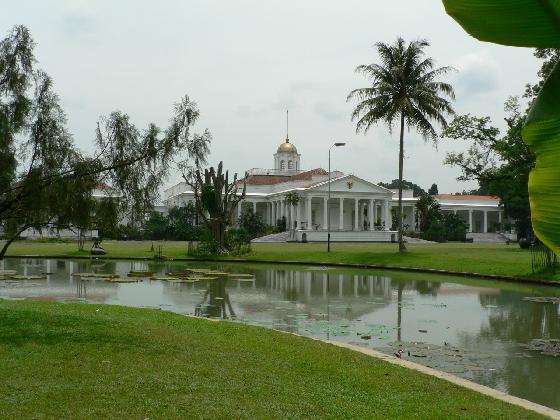
Bogor Botanical Garden

Bogor Botanical Garden

The present-day Bogor Botanical Gardens were originally part of the Samida forest, which was established around the time of the Sunda Kingdom under the rule of Sri Baduga Prince, also known as Prabu Siliwangi (1474-1513), as described in the Batutulis inscription. The Samida forest was created to protect rare wood seeds. Another Samida forest, known as the Ciung Wanara Forest, was established near the border of Bogor and Cianjur. However, it was abandoned after the defeat of the Sunda Kingdom by the Banten country.
Bogor Botanical Garden


In 1744, the Dutch East Indies Company built a mansion and garden on the site of the present-day Bogor Botanical Gardens in Buitenzorg. In 1811, Stamford Raffles became the Lieutenant-Governor of Java and had the Buitenzorg garden landscaped, where his wife Olivia Raffles died in 1814. A memorial was erected in her honor, which still stands in the Bogor Botanical Gardens today. In 1817, the garden was officially recognized as a botanical garden and was called 's Lands Plantentuin, an idea introduced by German-born Dutch botanist Caspar Georg Carl Reinwardt. 

Throughout the 19th century, the gardens were used for researching and cultivating plants and seeds from other parts of the Dutch East Indies. This tradition continues today, and the gardens are known as a center for botanical research. In 1848, the West African feather palm was introduced to the gardens, believed to be the mother tree in West Africa from which various descendants were propagated to support the growth of the oil industry in the region. In 1862, the Cibodas Gardens were established as an extension of the Bogor Botanical Gardens, and in 1889, the Teysmann Garden was established in honor of Johannes Elias Teijsmann, who was the director of the Bogor Botanical Gardens from 1830 to 1869. The Teysmann Garden follows formal European designs.


In 1928, the Astrid Avenue was established on the eastern side of the Bogor Botanical Gardens, containing a stunning display of lilies of various colors in memory of a visit by Princess Astrid of Belgium. In 1994, the APEC Heads of Government meeting was held next to the gardens at the Bogor Palace. The gardens were used throughout the APEC summit in Indonesia, attended by 60 world leaders, which formalized the Bogor Declaration. 

Today, the Bogor Botanical Gardens boast more than 15,000 species of trees and plants, with 400 exceptional palm varieties on display throughout the lawns and avenues. The gardens provide a sanctuary for over 50 different bird species and groups of monkeys that roost high up in the trees. The garden's flower houses contain around 3,000 varieties. In 1862, the Cibodas Botanical Gardens were established as an extension of the Bogor Botanical Gardens, located approximately 45 kilometers southeast of Bogor. The Bogor Botanical Gardens are home to five titan arum plants, all from Pagar Alam, South Sumatra, which is the largest number of specimens among botanical gardens. The most recent flowering events occurred in June and July 2011.


Cinta Laura : German-Indonesian role player

Cinta Laura


Cinta LauraCinta Laura Kiehl is a German-Indonesian actress, electropop singer, and model in Indonesia. She began her career in 2007 and has starred in numerous TV series and movies while also working with various local and international brands. Over the years, she has won many awards for her acting and singing, including two from the "Nickelodeon Kids Choice Awards Indonesia" and "SCTV Awards." Her debut single, "Oh Baby," was part of the soundtrack for her film of the same name. Cinta Laura proudly claims to be a citizen of the world, as she was born to a German father and Indonesian mother, Michael and Herdina Kiehl. Due to her father's work as a hotel manager, Cinta Laura spent most of her childhood traveling around the world, moving from country to country every two years, which has heavily influenced her Americanized accent. Before making her debut on Indonesia's TV screens, she learned enough Indonesian language to speak it fluently. She also starred in the film "Oh Baby" by MD Entertainment in 2008. In addition to her acting and modeling career, she is also known for her music and has released several albums and singles.

Cinta Laura Kiehl's debut film "Oh Baby" did not receive critical acclaim, but its soundtrack became very popular among teenagers not only in Indonesia but also in neighboring countries like Malaysia and Brunei. Additionally, she was selected by AXN channel to be the regional icon for their new program "Dance Off," which was a surprise to many. 

Cinta Laura is also active in charity work and has a foundation called "Soekarseno Peduli" which helps to rebuild damaged schools in Bogor, Indonesia. The foundation has collaborated with several multinational corporations and NGOs and has assisted over 4000 children since its establishment in 2003. After the success of her debut single, "Oh Baby," Cinta Laura collaborated with couple arthropod genus on the song "Penghianat Cinta" and Afgansyah Reza on the song "Let's Get the Beat." In January 2010, she released her first studio album, "Cinta Laura," which sold over a million copies and received a record-breaking thirteen times platinum from sales in Indonesia, Malaysia, and Brunei.


Saturday, 19 July 2014

Bank Rakyat Indonesia

Bank Rakyat Indonesia


Bank Rakyat IndonesiaBank Rakyat Indonesia (BRI) is a bank in Indonesia that is 70% owned by the government. This bank has been government-owned since Indonesia's war of independence from 1945 to 1949, and it was first established in 1895 as the "Aid and Savings Bank for Local Civil Servants" during the colonial period. Over the years, the bank underwent several name changes before becoming the "People's General Credit Bank" in 1934. During World War II, the bank's operations were impacted by the Japanese occupation, and after Indonesia declared independence in 1945, the bank was nationalized by the new government and renamed "Bank Rakyat Indonesia Serikat."

The bank's structure largely followed government policies under President Sukarno and President Suharto, moving rapidly towards socialism and then state authoritarianism. In 1992, the bank gained its current name and status. During the East Asian financial crisis of 1997, BRI was largely unaffected as it had limited lending in foreign currencies or to large corporations borrowing heavily overseas, unlike most other Indonesian banks. Since then, BRI has focused on increasing its core business and improving risk management practices. The government has reduced its influence on the bank's day-to-day operations, culminating in an IPO in 2003, and BRI is working towards complying with Basel II accords mandated by Bank Indonesia by 2008.

Bank Negara Indonesia

Bank Negara Indonesia

Bank Negara Indonesia (BNI) is an Indonesian bank with branches primarily located in Indonesia, but also in Singapore, Hong Kong, Tokyo, London, and New York. In 2006, it had 1000 branches and over 9 million customers. It is listed on the Indonesia Stock Exchange as "BBNI," with a market capitalization of approximately US$2.6 billion as of 12 March 2007.

BNI was established on 5 July 1946 and was intended to be the Central Bank of Indonesia, responsible for issuing and handling Indonesian currency. A few months after its establishment, BNI officially distributed the first official currency of Indonesia - ORI or Oeang Republik Indonesia.
Bank Negara IndonesiaBank Negara Indonesia (BNI) had its role shifted to that of a development bank after the appointment of De Javasche Bank as the Central Bank of Indonesia. Following increased capitalization in 1955, the legal status of BNI was changed into that of a commercial bank, and it officially opened its first foreign branch in Singapore that same year.

After a merger period with several other commercial banks, BNI's function and individuality were restored in 1968, with its official name changed to 'Bank Negara Indonesia 1946'. The bank underwent an operational restructuring program to improve its performance, and changed its corporate logo to a sailing boat to signify its aspiration to play a more international role.

In 1992, state-run banks were given the opportunity to change their legal status into Limited State-Owned Corporations, with BNI's name officially replaced with 'PT. Bank Negara Indonesia (Persero)'. The bank became a public company in 1996 through an initial public offering of its shares, and underwent the government's banking recapitalization program after the economic crisis.

In 2004, BNI introduced a new logo and shortened its nickname to "BNI'46".

Bank Danamon

Bank Danamon


PT Bank Danamon Indonesia Tbk. is a prominent Indonesian bank that was founded in 1956 with the original name of Bank Kopra. In 1976, the bank changed its name to Bank Danamon, derived from "dana moneter," meaning monetary fund. In 1988, Bank Indonesia enacted major banking reforms to encourage competition in the banking sector, which lowered the barrier to entry and resulted in Bank Danamon becoming one of the first foreign exchange banks in Indonesia. Today, Danamon is the largest financial institution in Indonesia by the number of employees, with a focus on fulfilling all of its customers' needs.

Danamon's business approach is centered around universal banking, which it implemented in 2003. By the end of 2004, Danamon had completed its array of business segments, spanning from mass market, SME & Commercial banking, retail banking, cards business, syariah banking, corporate banking, treasury, capital markets & financial institutions, in addition to Adira Finance. Danamon's acquisition of American Express card business in Indonesia in 2006 made the bank one of the largest card issuers in the country. Danamon is one of the largest and strongest financial institutions in the region, having survived a merger of 9 Bank Taken Over during the Asian financial crisis which began in the late 1990s.

Danamon aims to be "The Leading Financial Institution in Indonesia" with a significant market presence. It focuses on being a customer-centric organization covering all customer segments with a unique value proposition, centered on sales and service excellence and supported by world-class technology. The bank aspires to be an employer of choice, respected by all of its stakeholders, while embracing its values of caring, honesty, passion to excel, teamwork, and disciplined professionalism.

Danamon currently ranks as the 6th largest bank by asset size in Indonesia and operates the 2nd largest branch network with over 2,900 branches and points of sales, including its Danamon Simpan Pinjam (DSP) and Syariah units as well as its subsidiaries' branches. Danamon is also supported by a comprehensive array of electronic banking conveniences.

Thursday, 17 July 2014

Shendy Puspa Irawati : Indonesian badminton player

Shendy Puspa Irawati


Shendy Puspa Irawati
Shendy Puspa Irawati is a talented female badminton player who represents Indonesia on the international stage. She is known for her prowess in women's doubles matches and has competed in several high-profile tournaments throughout her career.

One of Shendy's most notable appearances was at the 2008 Indonesia Super Series, where she and her partner, Meiliana Jauhari, competed in the women's doubles event. Despite facing some tough competition, the pair managed to make it through to the semifinals, showcasing their impressive skills on the court.

Shendy also competed at the 2009 Malaysia Super Series and 2009 Korea Super Series, again teaming up with Meiliana Jauhari for the women's doubles matches. Although they didn't make it as far as the semifinals in these tournaments, Shendy and her partner put up a strong fight against some of the world's top badminton players.

Throughout her career, Shendy has demonstrated an unwavering dedication to her sport, putting in countless hours of practice and training to improve her skills and maintain peak physical fitness. Her hard work and determination have earned her a reputation as one of Indonesia's most talented badminton players, and she continues to inspire others with her passion and commitment to the game.